

The current issue regarding transgender women using women-only spaces is a highly debated legal, social, and political topic, centred on how to balance the rights, safety, privacy, and dignity of both trans women and cisgender (biological) women.
The debate has shifted from general social disagreement to specific legal frameworks and institutional policies, particularly following significant regulatory updates.
The Core Conflict
The debate primarily focuses on spaces like public toilets, changing rooms, domestic abuse refuges, hospital wards, and prisons. The two main perspectives involve:
Gender-Critical/Sex-Based Rights Arguments: Proponents of this view argue that women-only spaces were created to provide privacy, dignity, and safety for biological females from biological males. They maintain that because trans women are biologically male, their presence in these spaces can compromise the privacy or sense of safety of cisgender women, regardless of the trans woman's identity or legal status
Trans-Inclusive/Gender Identity Arguments: Proponents of this view argue that trans women are women and should be fully included in women's spaces. They emphasise that forcing trans women to use male facilities puts them at a high risk of harassment, discrimination, and physical violence. They also argue that excluding trans women isolates them from public life and undermines their legal recognition.
Recent Legal Developments
The issue has become heavily codified following landmark legal decisions and regulatory shifts:
- The Supreme Court Ruling on ‘Sex’: In 2025, the UK Supreme Court ruled that the definition of ‘sex’ within the Equality Act 2010 refers strictly to biological sex. This established that a person's legal sex for single-sex service exceptions is based on their birth sex, meaning a Gender Recognition Certificate (GRC) does not automatically grant a trans woman the legal right to access biological single-sex spaces.
- The EHRC Code of Practice (May 2026): In May 2026, the Equality and Human Rights Commission (EHRC) introduced an updated statutory code of practice. It confirms that service providers, businesses, and public bodies can restrict access to toilets, changing rooms, and associations based on biological sex.
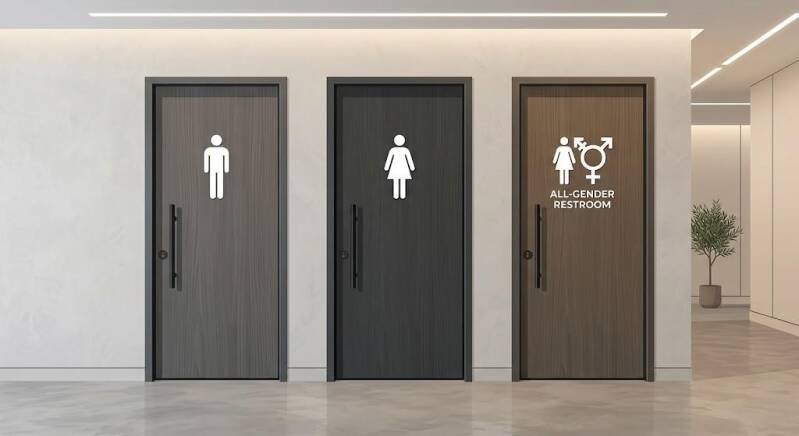
- The Requirement for Alternatives: Crucially, the 2026 guidance mandates that if a service provider excludes trans individuals from single-sex spaces, they must provide a suitable alternative—such as individual gender-neutral cubicles or third spaces. Leaving a transgender person with no facilities at all is still considered discriminatory under the law.
Current Institutional Responses
Because the law allows blanket exclusions only if they can be objectively justified as a ‘proportionate means of achieving a legitimate aim’ (such as privacy or safety), different institutions are handling the rule differently:
Workplaces and NHS Trusts: Many employers and hospital trusts are restructuring facilities to offer dedicated male, female, and individual gender-neutral options to comply with both health and safety laws and anti-discrimination protections.
- Local Councils and Recreational Spaces: Some public spaces have chosen to remain fully trans-inclusive. For example, in June 2026, the City of London Corporation voted overwhelmingly to maintain its policy allowing trans women to use the Hampstead Heath women's bathing ponds, deciding to add more private individual cubicles rather than banning trans individuals.
- The Statistical Contrast: LGBTQ+ advocacy groups frequently point out that despite the intense political debate, empirical data (such as a June 2026 UK Council FOI report) show an overwhelming absence of actual public complaints regarding trans women using single-sex spaces in daily life.
What the Polling Data Shows
When women are surveyed anonymously by polling organisations (such as YouGov or the EHRC), their responses show a complex mix of general tolerance alongside distinct boundaries regarding specific facilities:
- Higher Acceptance for Trans Women Than Men Express: Across multiple long-term studies, women consistently express higher levels of support for trans rights than men do. For instance, past YouGov data indicated a plurality of women supported trans women using women’s toilets (45% in favour vs. 34% opposed) and women’s domestic abuse refuges (45% in favour vs. 30% opposed), whereas male respondents were significantly more restrictive.
- Declining Comfort in Recent Years: More recent tracking data indicates a downward trend in comfort levels. Polling commissioned by gender-critical organisations such as Sex Matters suggests that overall public support for unrestricted access has dipped, with a notable share of respondents preferring a ‘separate but equal’ approach.
- The "Nakedness" and Intimacy Boundary: Women draw sharp distinctions based on the type of space. While comfort is generally higher in public toilets (where individual stalls provide privacy), it drops significantly in spaces involving partial or full nudity—such as open changing rooms, showers, and communal hospital wards. The lowest level of support among women is for trans women providing intimate, hands-on personal care to vulnerable or elderly females.
What Daily Experience and Official Complaints Show
There is a sharp contrast between the intense political debate seen in the media and how women behave in daily life.
- An Overwhelming Absence of Complaints: Empirical data show that women rarely lodge formal complaints about trans women in everyday settings. A TransLucent Freedom of Information (FOI) Report auditing public bodies across the UK found an average of only five documented complaints over four years.
- The ‘Passing’ Factor: In everyday public interactions, many women note that they only care or notice if a person noticeably retains male secondary sex characteristics or behaves inappropriately. If a trans woman ‘passes’ or simply uses a private cubicle discreetly, most women report being entirely unaffected or unaware.
The Main Arguments articulated by Women
The qualitative debate among women generally splits into two primary, deeply held philosophical camps:
The Gender-Critical / Sex-Based Rights Perspective
Women who advocate for strict, biological exclusions argue that women-only spaces are a hard-won civil right necessary for safety, dignity, and trauma recovery:
- Privacy from the Male Body: They argue that the psychological comfort of a woman-only space depends entirely on the exclusion of the male anatomy, regardless of how a person identifies.
- Trauma and Vulnerability: In spaces like domestic abuse refuges or rape crisis centres, advocates emphasise that many women are fleeing male violence. They argue that the presence of someone who is biologically male can trigger trauma, regardless of that person's intent.
- The Safeguarding Loophole: They voice concern that if ‘self-identification’ is the only barrier to entry, predatory biological men could abuse the system to gain access to vulnerable spaces under the guise of being transgender.
The Intersectional / Trans-Inclusive Perspective
Women who advocate for the full inclusion of trans women view the issue through the lens of human rights, safety, and shared womanhood:
- Shared Vulnerability to Men: Inclusive women argue that trans women are also highly vulnerable to male violence, harassment, and assault. Forcing a trans woman to use a male facility puts them in severe danger.
- Policing Cisgender Women: Many cisgender women express fear that strict biological checking harms them directly. According to Gendered Spaces and the Impact of the Supreme Court Judgement/EHRC Interim Update on Trans, Intersex and Gender Non-Conforming Adults, naturally tall women, who have sharp features or dress in a gender-nonconforming way, report increasingly being harassed, challenged, or threatened by people attempting to ‘weed out’ trans women from public toilets.
- Practicality of Stalls: They argue that modern infrastructure—such as floor-to-ceiling private toilet cubicles and private changing stalls—already completely solves the privacy issue without needing to ban or humiliate trans individuals.
Summary of the Consensus Solution
When women are asked how to resolve the tension, the most popular middle-ground solution across almost all demographics is infrastructure reform. Rather than forcing trans women into male spaces or forcing cisgender women to share open communal spaces, the vast majority of women support maintaining traditional male/female spaces while adding individual, self-contained gender-neutral cubicles to give everyone maximum privacy and choice.
Final Thoughts
Ultimately, the core of this debate rests on a fundamental principle: women have a hard-earned, established right to single-sex spaces designed specifically to ensure their privacy, safety, and dignity from biological males. Drawing a parallel to sports regulation, just as qualification for the Paralympics requires meeting strict, objective physical criteria rather than a subjective identity (you have to be disabled rather than think you are), access to single-sex spaces must be governed by objective biological sex. From this perspective, the conversation should not be framed as a conflict between women and trans individuals, nor should women be asked to sacrifice their established protections. Instead, the responsibility lies with the government to ensure that transgender individuals—as biological men—have access to separate, dedicated safe spaces that protect their dignity without infringing upon the foundational, sex-based rights of women.
#Genderspaceandimpact #FOIReportTranswomen #Supremecourtruling2026
Add comment
Comments