

Government tax policies face intense scrutiny as households feel the pinch of consecutive tight budgets. While raising direct taxes on individuals is often framed as a way to fund public services, it frequently triggers a damaging economic cycle: it strips away the exact consumer spending power required to drive long-term economic growth. When the state intercepts money before individuals can spend it, the broader economy suffers from a suppressed “multiplier effect”.
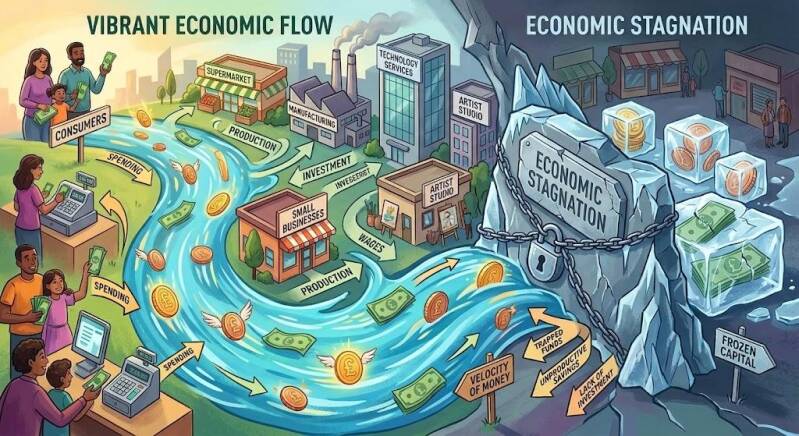
The Economic Ripple Effect of Consumer Spending
A healthy economy relies on the continuous velocity of money. When an individual has disposable income, their financial decisions spark a chain reaction of tax revenue and business growth:
[Consumer Has Cash] ➔ [Buys Goods/Services (Generates 20% VAT)] ➔ [Business Increases Revenue & Pays Corporation Tax] ➔ [Business Buys from Suppliers (More Sales Tax)] ➔ [Suppliers Hire Workers & Pay Wages (Income Tax/NICs)]
- The Initial Sale: A consumer purchasing a new car, booking a holiday, or upgrading home appliances instantly generates 20% VAT for the Treasury.
- The Business Reaction: That purchase boosts the business’s revenue, leading to higher Corporation Tax payments.
- The Supply Chain: To meet demand, that company purchases materials and services from other UK suppliers, generating further business-to-business sales and tax receipts.
- Job Creation: Thriving businesses retain and hire staff, creating a robust cycle of income tax and National Insurance Contributions (NICs).
When direct taxation aggressively targets personal income or assets, it halts this cycle before it even begins. Money is pulled directly out of circulation, leaving high streets quiet and businesses stagnant.
The Looming Threat: Mansion Taxes and Capital Gains
With the leadership transition within the Labour Party following Keir Starmer’s resignation, incoming figures like frontrunner Andy Burnham are floating new tax proposals. Speculation surrounds a widespread “mansion tax” alongside aligning Capital Gains Tax (CGT) directly with income tax rates.
While these policies are marketed as targeting wealth rather than work, the real-world consequences hit the wider economy:
The Impact of an Expanded Mansion Tax
The government intends to levy an annual tax on higher-value properties to fund public services. In reality, this squeezes middle-class family budgets. Homeowners quickly halt local building developments, house renovations, and tradesperson contracts to offset the cost.
The Impact of Capital Gains Tax Realignment
The proposal aims to raise Capital Gains Tax to match standard income tax bands up to 40%. In practice, this heavily disincentivises investment, pushes landlords to exit the rental market entirely, and completely stalls property transactions.
The Cost of a Stagnant High Street
The true casualty of over-taxation is the everyday consumer’s quality of life. When disposable income shrinks, households are forced to delay essential upgrades and lifestyle choices:
- Home Renovations: Postponing extensions or boiler upgrades starves local plumbers, electricians, and builders of work.
- Retail Spending: Avoiding major appliance purchases or new car upgrades leaves domestic manufacturing and retail sectors struggling.
- Hospitality & Tourism: Skipping weekend breaks, restaurant dinners, and family holidays directly impacts local high streets and hospitality venues.
The Bottom Line: Taxing to Death vs. Growing the Pie
A government cannot tax its way to prosperity. True fiscal sustainability is achieved by expanding the overall economy, not by taking a larger bite out of a shrinking pie.
If leadership keeps underestimating the power of consumer spending, the UK risks entering a cycle of low growth and falling tax yields. True national wealth is generated on the high street, through competitive businesses, and by allowing hard-working individuals to keep more of their money to spend as they choose.
Add comment
Comments