

Tolkien’s Warning: The Architecture of Lawful Evil
In the ancient Roman world, as dramatised in I, Claudius, a junior senator watches an innocent man get tortured to death by an authoritarian regime. His final realisation is profound: he always knew the regime's true nature because he possessed a "sense of smell" about them. Today, our cultural and financial institutions are failing a basic smell test.
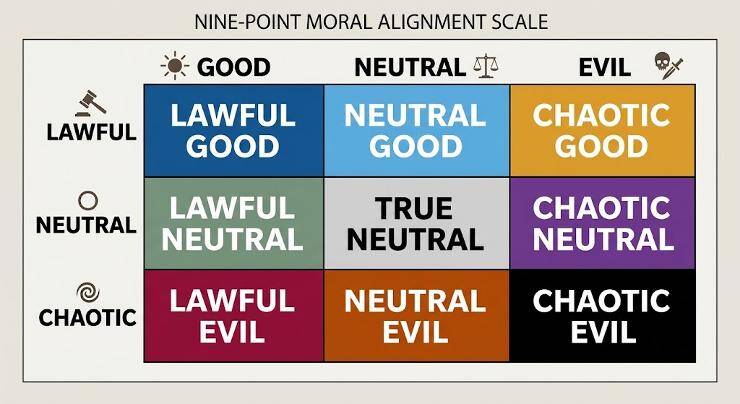
To understand how bad actors weaponise institutions, we can look at the classic 9-point moral alignment matrix used in literature and role-playing games. It is easy for society to unite against Chaotic Evil—the violent, angry forces running through the streets breaking things. They are obvious.
The far more dangerous threat to a free society is Lawful Evil. Lawful evil characters do not break the law; they use the law to inflict harm.
Lawful Good
- Mr Justice Goose (The High Court Judge): Enforces traditional British justice with absolute, sovereign authority. He rejects bureaucratic cowardice and uses the full force of the law to compel a criminal to face accountability, protecting public trust.
Neutral Good
- The Common-Sense Citizen: A local community member who quietly ignores unhelpful council red tape to fix a neighbourhood issue, prioritising everyday safety and the well-being of their neighbours over administrative compliance.
Chaotic Good
- The Institutional Whistleblower: An insider who intentionally violates corporate non-disclosure agreements or bureaucratic rules to expose systemic corruption, bypassing the captured system to protect individual autonomy.
Lawful Neutral
- The Compliance Officer / Human Resources Manager: A careerist who rigidly enforces company policies, systemic restructurings, and workplace regulations. They do not act out of malice, but out of a strict adherence to corporate procedures.
True Neutral
- The Disengaged Careerist: The standard institutional operator who is completely indifferent to ideological battles. They simply "follow the money," focusing entirely on personal career advancement and job security.
Chaotic Neutral
- The Disruptive Online Influencer: An individual who actively mocks and undermines established social norms and institutional narratives, driven not by a specific political ideology, but by a personal desire to cause disruption and chaos.
Lawful Evil
- The "Small-Town Sauron" / Progressively Blinded Elites: Bureaucrats who weaponise minute grants of authority to control their neighbours, or legal elites who deliberately mislead the public by claiming the state is "powerless" to stop a crisis, all to justify expanding state control.
Neutral Evil
- The Opportunistic Profiteer: Corporate actors or radical group leaders who exploit ongoing social stability and institutional weakness for purely selfish, malicious financial gain, entirely unconcerned with structural or moral outcomes.
Chaotic Evil
- The Radical Revolutionary / Rioter: The violent, angry forces running through the streets breaking things. They smash traditional norms, create systemic instability, and act with a completely untethered, destructive nature.
Tolkien’s The Lord of the Rings highlights this deceptive power of absolute control. The architecture of tyranny is rarely ugly at first glance; Sauron was originally highly attractive and persuasive before his true form was revealed. Lawful Evil manifests as the small-town bureaucrats who abuse small grants of authority to control their neighbours, or the institutional operators who use compliance, corporate red tape, and systemic restructuring to slowly choke out individual autonomy.
The Meaty Strength of Traditional Justice
Modern Fabian systems are fundamentally weak, passive-aggressive structures. When these systems inevitably fail, the establishment’s immediate reaction is to claim they are "powerless" and demand sweeping new legislative powers to solve a crisis they manufactured.
We saw this dynamic play out perfectly on the national stage when a high-profile criminal defendant weaponised the system by aggressively refusing to leave his cell to face the dock. Progressive legal elites and figures like Lord Falconer rushed to the airwaves, wringing their hands and claiming that judges were legally toothless, demanding that Parliament urgently draft a brand-new law to compel criminals into the dock. It was a complete and utter lie designed to mislead the public into thinking the state lacked authority.
The presiding High Court judge, Mr Justice Goose, didn’t indulge in this modern cowardice. He demonstrated the strong, meaty strength of traditional British justice. He gave a clear, unshakeable command: It is not your choice. You will be dragged out of those cells by force, and you will stand in this dock. He didn't wait for a new act of Parliament or care about the emotional comfort of the bureaucratised legal class. He enforced the law with absolute, sovereign authority.
The Weimar Fallacy
The vast majority of people occupying our captured institutions are not fanatical believers. They are careerists following the money. But while a landslide shift back toward common sense is entirely possible once the incentive structures are fixed, the temporary alliance between moderate bureaucrats and radical actors carries a terrifying historical precedent.
There is a dangerous, parasitic symbiosis between moderate left-wing managers (the Social Democrats) and the radical, revolutionary left (the Marxists). The technocratic managers frequently want radical societal transformation but lack the stomach for the conflict required to achieve it. They quietly allow radical activists to run around smashing traditional norms, using their disruption to justify expanding state control.
Inevitably, the moderate managers lose control of the radicals. The chaos they tolerated destabilises the social fabric so thoroughly that the public eventually panics, creating a desperate demand for a strongman to restore order at any cost.
[Weak Techocratic Managers] ➔ [Tolerance of Radical Disruption] ➔ [Systemic Instability] ➔ [Public Panic] ➔ [The Rise of Tyranny]
Historical data regarding the collapse of the Weimar Republic and the rise of the Nazi Party reveals a chilling truth: the median voter who swept Hitler into power wasn't a radical ideologue. The standard voter was a young, anxious mother. She didn't vote for tyranny because she shared a fanatical hatred; she voted for an extremist because she was utterly terrified that the breakdown of public order would destroy her children's future. When a state's ruling elite allows ideological tantrums to destabilise everyday safety, they create the exact psychological conditions that cause ordinary people to accept monstrous regimes out of sheer survival.
The Final Thought: The Mirage of the Managerial Safe Space
The ultimate tragedy of the modern bureaucratic state is that its obsession with safety inevitably manufactures the exact conditions for its own destruction. By replacing the "meaty strength" of traditional, absolute justice with passive-aggressive compliance structures, our captured institutions do not eliminate conflict—they merely outsource it to the streets.
When technocratic managers tolerate radical disruption in the hope of expanding their own administrative authority, they play a terminal game of chicken with human nature. Order is not an optional luxury; it is a psychological necessity. If a society’s legitimate institutions refuse to guarantee everyday safety because they are trapped in a labyrinth of their own paperwork, the public will not wait for a new act of Parliament. They will eventually bypass the small-town Saurons entirely, trading the slow, suffocating death of Lawful Evil for the brutal, immediate certainty of a strongman. The preservation of freedom relies not on the expansion of bureaucracy, but on the courage of leaders who still possess the stomach to enforce the law.
Add comment
Comments