

A political earthquake has just shattered the foundations of German politics. Recent regional results out of Saxony-Anhalt have confirmed an unprecedented, crushing victory for the Alternative for Germany (AfD)—a party previously designated as right-wing extremist by domestic intelligence services. In a historic result that has stunned the Western political establishment, the AfD didn't just win—they dominated. Moving far past early projections of 29%, the party captured nearly 44% of the final vote, putting them on the absolute brink of taking total regional power over law enforcement, school systems, and cultural institutions.
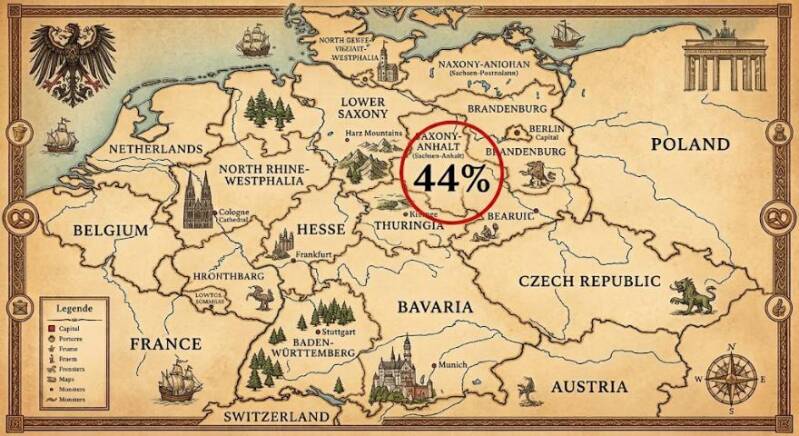
Meanwhile, Chancellor Friedrich Merz’s centre-right establishment has suffered a historic humiliation, with his party's support cut cleanly in half to a disastrous 17%. Backed by a staggering 85% voter dissatisfaction rate across the country, this is no longer a standard regional election. It is a decisive, "Brexit-style" revolt that signals a deep, systemic rejection of mainstream politics, reverberating far beyond Berlin
The Secret Statistics Driving a "Deportation Offensive"
At the absolute core of this sudden political shift is a complete collapse of public trust surrounding mass immigration and law and order. State AfD leader Ulrich Siegmund campaigned on a strict "remigration" platform, promising an immediate halt to Germany's traditional asylum system.
The raw numbers explaining the voters' rage are impossible to ignore:
- Between 2011 and 2022, Germany was flooded with hundreds of thousands of asylum applications.
- By a recent year-end, 232,000 migrants were legally ordered to leave the country.
- Out of those hundreds of thousands, only 22,000 were actually deported.
To a massive portion of the electorate, this massive gap represents a total breakdown of the rule of law. Mainstream centrist parties spent years dismissing citizens' growing concerns over illegal immigration and street-level crime as "extreme" or "racist", completely ignoring operational government failures until the system hit its breaking point.
The Illusion of the "Nice Veneer"
What made the AfD's massive surge invisible to mainstream pollsters was a massive establishment blind spot. Figures like the 35-year-old Siegmund present a young, articulate, and highly polished veneer to the public. They validate the average citizen's day-to-day anxieties while gradually mainstreaming highly controversial policies. Traditional politicians arrogantly assumed that comparing the AfD to mid-20th-century nationalism would automatically outrage the public. They fundamentally underestimated how deeply the average voter felt alienated by Berlin. While everyday voters explicitly condemn Nazism, critics frantically point to the party's manifestos, warning of unsettling structural parallels that start passively before aggressively expanding.
A Continental Trend: The 1-in-4 Rule
Make no mistake: Germany is not an isolated incident. A massive right-wing network is systematically sweeping across the European continent, with nearly one in four Europeans now backing populist or nationalist parties:
- Germany: The AfD is poised to send ministers to the Bundesrat (upper house), allowing them the direct legislative power to stall federal laws on migration, green energy, and the EU Asylum Act.
- France: Marine Le Pen’s National Rally has exploded to become the largest single party in the French parliament, dominating national polling.
- Austria: The anti-establishment FPÖ is currently decimating its rivals, leading national polls at a massive 36%.
- Italy: Giorgia Meloni continues to firmly command the most right-wing coalition government in Italy's post-war history.
A Severe Warning for the UK and the West
While continental Europe rapidly pushes back against globalist agendas, nations like the UK appear to be moving in the opposite direction. However, political analysts warn against complacency. The establishment's historical strategy of forming messy "firewall" coalitions solely to keep populist parties out of power is actively backfiring. Voters increasingly view these elite alliances as a mockery of the democratic process, which only fuels even larger populist landslides down the road.
The seismic shift in Saxony-Anhalt delivers a brutal lesson to the Western political class: if mainstream parties refuse to confront complex issues like border security and public safety, the populist right will gladly step into the vacuum.
Add comment
Comments