

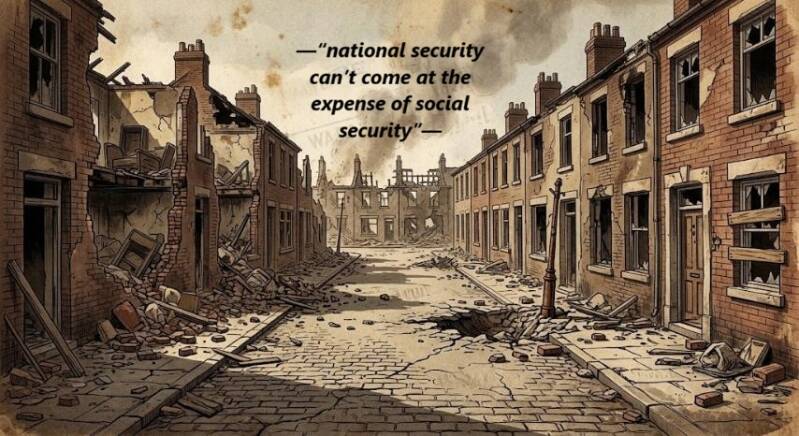
When political leaders run out of ideas, they fall back on a well-worn playbook: they turn serious governance into a morality play. We saw this starkly on display during Prime Minister’s Questions, where Prime Minister Andy Burnham’s rehearsed, focus-grouped line—“national security can’t come at the expense of social security”—delivered exactly what his team wanted: a perfectly clipped, social media-friendly soundbite.
But beneath the polished delivery and the smug smiles lies a deeply cynical strategy. This isn't about governing; it’s about survival. This is a government gearing up the base for an upcoming general election, speaking the exact language needed to bring the left-wing faction, floating Green voters, and former Corbynites back into the fold. Anti-Israel rhetoric, pro-welfare expansion, and empty slogans are the currency of this strategy, designed specifically to pacify an increasingly fractured voter base.
The Illusion of the "Nice" Left
For decades, a strange cultural phenomenon has persisted in British politics: the instinctive belief among many voters that being on the political left automatically makes you a "nicer" person. The current administration exploits this bias ruthlessly. When in doubt, they play morality politics. If you challenge their spending, they don't offer an economic argument; instead, they simply accuse the opposition of wanting to harm people.
This approach completely bypasses the brutal reality of economic management. The truth is that this administration fundamentally fails to comprehend the economy or the basic constraints of national budgets. They rely on focus-grouped scripts because the alternative—confronting the hard, mathematical realities of a ballooning state dependency crisis—is ideologically impossible for them.
A Fractured Opposition and an Unanchored Electorate
If the left’s ideological posturing is so transparent, why does it work? To be frank, it is because the political right has forgotten how to campaign. For too long, conservative and centre-right voices have operated under the lazy assumption that because their economic positions are logical, the public will naturally agree with them. They advocate for massive policy shifts without doing the legwork to explain why those changes are necessary, failing to engage with or listen to the broader electorate.
As a result, we now have an unanchored electorate. Recent data reveals that no single political party truly "owns" any major issue in the minds of the public anymore. The old, rigid boundaries of "left wing versus right wing" have largely dissolved. Since the mid-2000s, British politics has shifted. The public has become less ideological and more pragmatic; the average voter simply wants competence. They want to know: How are you going to deliver public services on time, under budget, and exactly as promised?
The Ultimate Reality Check
By prioritising the welfare state over hard defence infrastructure, the government is failing the ultimate test of competence. When you throw the question out to the public about what a government's absolute priority should be, the answer is fundamental and unchanging.
You can promise all the social safety nets, housing benefits, and community resilience funds you want. But it all amounts to nothing if you cannot secure the nation itself. To put it in the most stark, undeniable terms: We haven’t got a house if we are bombed out of it.
A government that refuses to make the hard choice to fund national defence isn't being "nice"—it is being completely irresponsible. It is time for Westminster to stop playing to the social media galleries and start acting like a mature government before our global standing, and our physical safety, are completely destroyed.
Add comment
Comments