

Democracy is not an administrative inconvenience. It is not a line item that central government can simply erase from the budget when the electoral calculus looks uncomfortable. Yet, we have witnessed an astonishing and brazen attempt by the Labour government to quietly rewrite the rules of British local democracy—only for the entire project to collapse in a series of humiliating, high-stakes U-turns.
What began as a bureaucratic crusade to aggressively redraft the map of local government has ended in a complete defeat for Downing Street, proving that even a massive parliamentary majority cannot insulate a government from the rule of law.
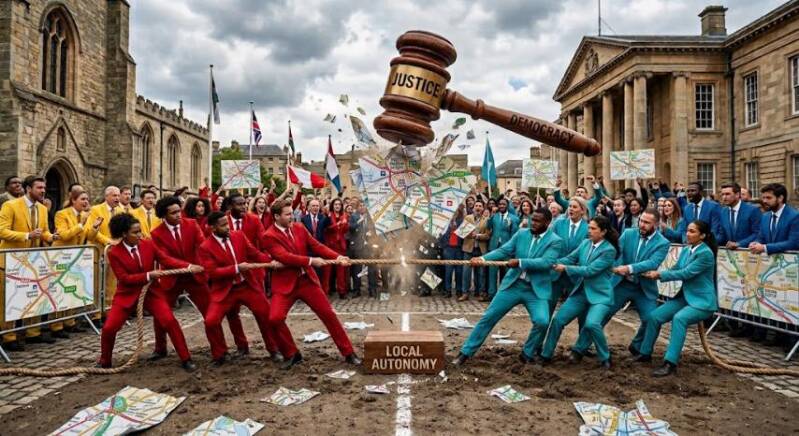
The Blueprint: Cancelling Elections Under the Guise of "Efficiency"
The saga began with a dangerous precedent. Under the banner of Local Government Reorganisation (LGR), the government set out to dissolve more than 100 historic district and county councils, forcibly merging them into massive, hyper-centralised "unitary authorities".
To pave the way for this centralisation of power, the government moved to postpone and effectively cancel local elections for roughly four million voters. The official excuse was that it would be a "waste of taxpayer money" to hold elections for "zombie" councils that were scheduled to be abolished anyway.
But critics immediately saw through the smokescreen. At a time when Labour’s popularity was already fracturing, the areas targeted for election cancellations happened to be regions where the government feared severe electoral punishment. As pressure groups rightly pointed out, it looked suspiciously like a government running scared from the electorate. You do not suspend the fundamental right of citizens to throw politicians out of office just because the timing is inconvenient.
The First Domino Falls: The Election U-Turn
The government assumed the public and opposition parties would simply roll over. They were wrong.
Facing an immense cross-party backlash, an aggressive media campaign, and a high-profile High Court challenge spearheaded by opposition campaigns, the government’s legal defence disintegrated. Government lawyers quietly admitted they were on track for a devastating defeat in court.
The government executed a panicked, total U-turn. They abandoned the delays, agreed to pay the opposition's legal costs, and rushed to reinstate the elections. It was a massive victory for democratic norms, sending a clear message: elections are a binding contract between citizen and state, not a gift to be paused at ministerial whim.
The Final Collapse: Reversing the Mergers
While the elections were saved, the government stubbornly insisted that the forced council mergers would still go ahead. Tens of thousands of hours and millions of pounds of taxpayers' money were burned by councils scrambling to comply with the state-mandated restructuring.
But the legal cracks created by the election U-turn quickly spread to the structural plans themselves. Threatened local councils launched a wave of judicial reviews, arguing that the top-down abolition of their authorities was legally flawed, bypassed local consent, and subverted fair representation.
Faced with a wall of impending defeats in the High Court, Housing Secretary Angela Rayner stood up in Parliament on the 7th September 2026, and pulled the plug.
The massive restructuring plans have now been shattered into three distinct categories. The government has completely axed and withdrawn the mergers in Essex, Hampshire, Norfolk, and Suffolk, ensuring these councils will remain completely independent. Meanwhile, the plans have been entirely suspended and placed under a full review across 14 other areas, including Devon, Kent, Lancashire, and Yorkshire. The sole exception to this nationwide collapse is Surrey, which is the only region proceeding with the reorganisation because its new unitary authority voting had already been completed.
Rayner confirmed that upcoming local elections will now go ahead on existing, traditional council boundaries. The grand plan to fundamentally restructure local government lies in tatters.
Why This Matters: A Warning to the Governing Class
This entire fiasco is a case study in executive overreach. The attempt to cancel elections and force structural mergers without the explicit consent of local communities was an extraordinary overestimation of central government power.
Had the government succeeded, it would have established a terrifying principle: that an incumbent administration can alter boundaries and suspend democratic voting whenever it deems a "national necessity" or "administrative efficiency" demands it.
The double U-turn over both the elections and the mergers proves that the UK's democratic checks and balances still function. When a government treats democracy like an optional extra, the courts, the opposition, and public scrutiny can—and will—force a retreat.
Final Thought: Trust is Hard to Build, but Easy to Destroy
Ultimately, this collapse is a stark reminder that true devolution cannot be delivered through dictatorship. If the government genuinely wishes to "rewire the state" and empower local communities, it must learn to work with them, not override them. Central government cannot claim to be expanding democracy with one hand while snatching away voting rights and local identities with the other. By treating local councils as pawns in a Whitehall numbers game, Labour did not just lose a legal battle—they severely damaged their own credibility. Moving forward, any future structural reforms will be viewed with deep suspicion, leaving a legacy of institutional distrust that will take years to heal. The maps remain unchanged, the ballots will be cast, and the ultimate winners are the British electorate, who successfully defended their right to choose who governs them.
Add comment
Comments