

A healthy, functioning democracy relies on visibility. Over the last few years, however, a disturbing shift has occurred on British streets. We have normalised a culture of anonymity.
Whether it is political agitators hiding behind masks at violent protests, delivery riders zipped up in black balaclavas weaving through traffic, or orthodox Islamic garments like the niqab and burqa, hiding one's face has become commonplace.
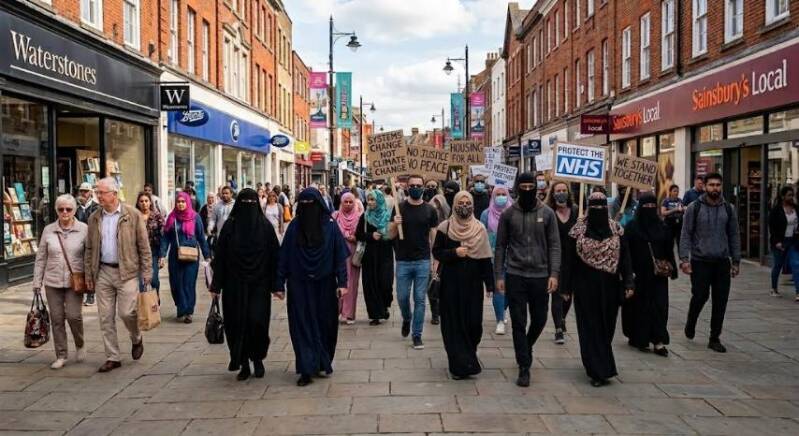
But this isn't just a minor security concern—it is a direct assault on our culture. Britain is historically and culturally a Christian nation built on openness, community, and mutual recognition. When we allow large groups of people to actively opt out of basic human interaction by concealing their faces, we are letting our social fabric unravel.
The Deceptive Cloak of Anonymity: From Protesters to Couriers
We see the danger of face coverings playing out across our public spaces every single day.
At political rallies and demonstrations, mask-wearing has become the default uniform for extremists looking to escape accountability. They don balaclavas and face masks not for health, but to terrorise the public, deface monuments, and assault police officers while evading facial recognition technology.
Meanwhile, our neighbourhoods are flooded with freelance courier and delivery drivers operating on electric bikes while wearing full face-masks. Pedestrians are left unable to identify who is speeding down the pavement towards them.
This creates an environment of low-level fear and lawlessness. If you are participating in British public life, operating a business on our streets, or exercising the right to protest, you should be required to show your face.
The Language of the Human Face: Why the Niqab and Burqa Alienate
This issue stretches directly into the ongoing debate surrounding religious dress—specifically the niqab and the burqa worn by some Muslim women. While the burqa covers the entire body and face with a mesh screen over the eyes, the niqab covers the mouth and nose while leaving a narrow slit for the eyes.
Both garments pose a massive barrier to social integration.
As human beings, we are hardwired to communicate through sight. Academic research and communication experts consistently show that spoken words represent only about 7% of human comprehension. The remaining 93% of meaning is derived from tone of voice and, crucially, facial expressions and body language.
We gain trust, read empathy, and establish mutual understanding by looking at a person's mouth, smile, and micro-expressions. When a garment erases the face, it completely kills the possibility of meaningful connection. It forces an unnatural, one-sided dynamic into daily British life, alienating those who wish to engage in simple, neighbourly interaction.
Europe Has Awakened—Why is Britain Lagging Behind?
Our continental neighbours recognised the social and security threats of public anonymity years ago and took decisive action. Total or partial bans on full-face coverings in public spaces are now active legal realities across a large portion of Europe:
- France & Belgium: Pioneered the movement by implementing nationwide public bans on all face-covering garments as early as 2011.
- Denmark, Austria, & Bulgaria: Enforced blanket bans covering streets, public transport, and government buildings.
- The Netherlands & Switzerland: Restrict face coverings in crucial public settings like schools, hospitals, and public transport.
- Italy: Long-standing anti-terrorism laws strictly prohibit garments that conceal a citizen's identity in public, with legislation heavily restricting the burqa and niqab in public institutions.
These European nations realised that a shared culture cannot survive if its citizens become entirely anonymous to one another. Yet, the UK remains a soft-touch outlier, terrified of being called intolerant, while our public spaces are progressively hollowed out by parallel societies.
Final Thought
If individuals choose to adopt religious customs or political styles that mandate hiding their appearance, those practices belong in the privacy of their own homes—or when people are outside of this country. But if you choose to walk on British streets, use British public services, and live within our Christian heritage of open community, you must respect our cultural norms. It is time to follow Europe's lead and ban public face coverings once and for all.
Add comment
Comments