

If entering Britain without the required permission can be a criminal offence under UK law, why have successive governments described unauthorised arrivals as merely “irregular”? And can a route really be illegal?
When Did Illegal Become Irregular?
Words matter. Particularly when those words are used by governments to describe whether someone has broken the law.
For years, the British public has heard the term “irregular migration” used to describe people arriving in the UK through unauthorised routes, including small boats crossing the English Channel. And this terminology was not introduced by Labour alone.
The Conservative government used it in official Home Office statistics, and Labour continued using it after taking office in July 2024. But what exactly is irregular about knowingly entering a country without the permission required by law?
Under Section 24(B1) of the Immigration Act 1971, a person who requires permission to enter Britain and knowingly enters without it can commit a criminal offence. The legislation does not describe that offence as an irregularity.
It calls it illegal entry.
So why have successive governments used terminology that sounds considerably less serious?
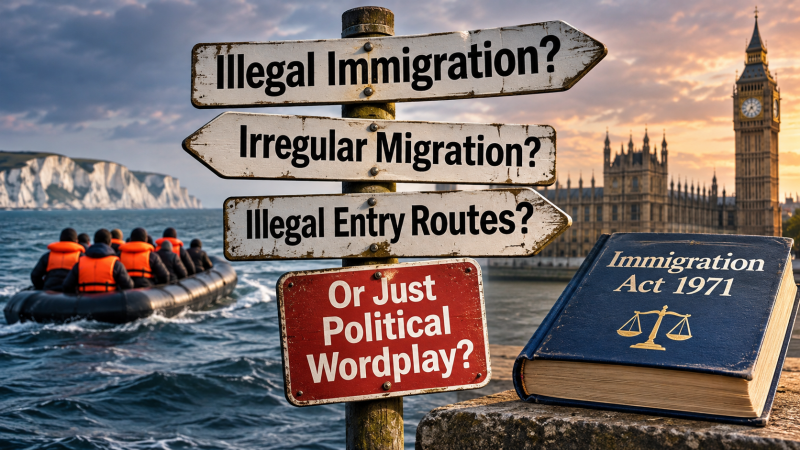
Imagine Applying That Logic to Other Crimes
Imagine if we applied the same approach to other offences.
Would we describe breaking and entering as an “irregular property entry”? Shoplifting as an “unauthorised retail transaction”? Or murder as an “intentional adjustment to someone's life expectancy”?
Of course not. It would be ridiculous.
Yet when it comes to immigration, successive Conservative and Labour governments have used the term “irregular migration” to describe a category of arrivals that includes people entering Britain in breach of immigration law.
If we wouldn't dream of sanitising the language surrounding other criminal offences, why should illegal entry be any different?
There is a difference between using precise terminology to recognise complex legal circumstances and using language that risks obscuring what has actually happened.
The public deserves to know which is which.
Can a Route Really Be Illegal?
In February 2026, the Home Office changed the terminology in its immigration statistics. What had previously been described as people arriving “irregularly” became people arriving via “illegal entry routes”. The change was presented as a change in terminology rather than in the underlying statistics. But that raises another rather obvious question.
How can a route itself be illegal?
It is not inherently illegal to travel in a boat, cross the English Channel or enter Britain by ferry. Nor does travelling in a lorry, by itself, determine whether someone has committed an immigration offence.
The legal issue is whether an individual enters the country without the permission required by law, and whether the circumstances satisfy the elements of an offence. So have we simply exchanged one potentially misleading expression for another?
First, successive governments described unauthorised arrivals as “irregular migration”. Now the Home Office refers to “illegal entry routes”, as though the method of travel itself determines criminality.
Surely the question should be whether the entry was lawful, not simply whether the person arrived by boat, lorry or aeroplane? A route may be associated with unlawful entry, but that does not mean every person travelling along it has committed an offence.
It is the legality of the individual's entry that matters, not the geographical route they travelled.
Illegal Entry and Immigration Status Are Two Different Things
There is an important distinction that governments should explain more clearly.
How someone enters Britain and whether they have the legal right to remain are two different matters.
Someone may enter Britain without permission, claim asylum and subsequently be granted the legal right to remain. However, that decision does not automatically change the circumstances of their original entry. Equally, someone may enter Britain legally on a visa but remain after it expires, leaving them without permission to stay. Refugee law also provides protections in certain circumstances, so entering without permission does not automatically mean someone has committed a prosecutable criminal offence.
The distinction is simple: entering Britain unlawfully and remaining in Britain unlawfully are not the same thing.
Surely the government should be capable of explaining that difference without confusing the public with constantly changing terminology.
Calling Something Illegal Isn't a Political Position
There seems to be an assumption in some political discussions that using the words “illegal immigration” is inherently inflammatory. But describing an act as illegal, where the law defines it as such, is not automatically a political judgement. It is a statement about the legal framework. Equally, describing an individual's immigration status accurately matters.
Not everyone who arrives by an unauthorised route has the same legal circumstances, and not everyone who claims asylum has committed a criminal offence. That distinction should be explained, not used as a reason to avoid the term illegal entry when it is legally appropriate.
We should be able to recognise the rights of genuine refugees without pretending that immigration laws do not exist.
The Public Deserves Clarity, Not Political Wordplay
Both Conservative and Labour governments have faced criticism over their handling of immigration, border enforcement and removals. Changing the language does not resolve those problems.
The Home Office's statistics have used terms including “irregular migration” and “illegal entry routes”. Meanwhile, public debate frequently moves between illegal, irregular, undocumented and unauthorised without explaining the differences. That creates confusion rather than confidence. If someone knowingly enters Britain without the required permission and commits an offence under immigration law, say so. If they subsequently receive asylum, explain that too. If their claim is refused and they have no lawful basis to remain, explain what action is being taken. And if removal is prevented by a legal protection, be transparent about why.
The public should not have to decipher political terminology to understand whether immigration law is being enforced.
Final Thought: Changing the Words Doesn't Change the Law
Britain has every right to maintain immigration laws and expect them to be enforced. It also has obligations towards people genuinely fleeing persecution. Those responsibilities are not mutually exclusive. But neither Conservative nor Labour governments should escape scrutiny for the language they use when discussing border security and immigration enforcement. Calling an arrival “irregular” does not determine whether it was lawful. Calling a route “illegal” does not establish that everyone using it has committed an offence. And granting someone permission to remain does not automatically change the circumstances in which they originally entered the country.
Entry, immigration status and the right to remain are three related but distinct matters.
Governments should be capable of explaining those differences in plain English without hiding behind vague expressions or politically convenient labels. Because the law should determine the terminology, not the other way around.
Changing the words doesn't change the law. And the British public deserves clarity, accuracy and honesty from whichever party happens to be in government.
Add comment
Comments