

For years, the overarching goal of UK welfare reform has been simple: ‘make work pay’. Universal Credit was explicitly designed to smooth the transition into employment, ensuring that taking on more hours would always leave a claimant financially better off.
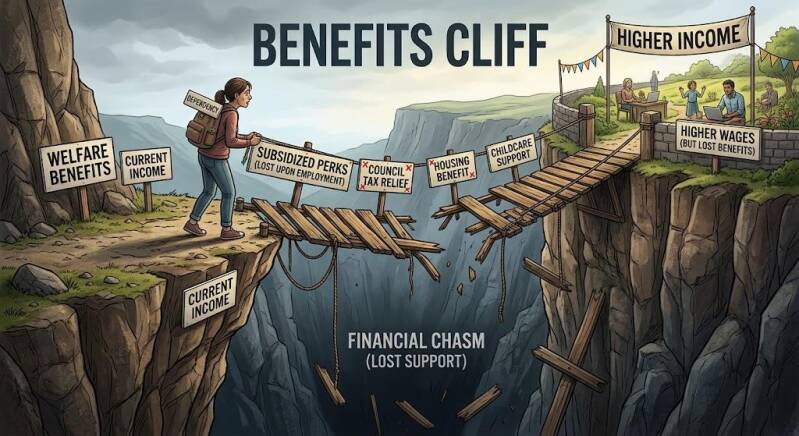
However, policy critics and welfare economists increasingly point to a glaring design flaw in the system. Rather than acting as a gradual ramp into financial independence, the structure of modern state support creates a sharp ‘benefits cliff’.
This phenomenon centres on the idea that government policies create perverse incentives to remain on state support. When a claimant takes on extra work, the hidden cash value of subsidised perks can disappear so abruptly that earning an extra pound in wages actually leaves them financially worse off.
The All-or-Nothing Penalty
The core problem lies in the rigid, binary nature of qualifying for auxiliary support. While the cash component of Universal Credit tapers off gradually as earnings rise, passported benefits—the extra perks available to claimants—often function as an all-or-nothing penalty.
Under current rules, essential provisions like council tax reduction, free school meals, and heavily subsidised public transport are tied directly to active welfare enrolment. The moment a worker’s salary crosses the threshold to exit Universal Credit, they lose the entirety of these auxiliary benefits simultaneously. Because the combined financial value of these ‘freebies’ is often much higher than a marginal wage increase, crossing the line can trigger an immediate financial penalty.
The Hidden Cash Value of ‘Freebies’
To truly understand why the system unintentionally encourages long-term benefit reliance, we must factor in the substantial non-cash value attached to Universal Credit enrolment. When these perks vanish, they create an immediate, expensive vacuum in a household budget.
-
Travel Subsidies: Many local councils offer discounted public transport or completely free travel passes for individuals on low incomes or specific welfare tiers. Stepping off benefits means paying full fare for the daily commute.
-
Health Costs: Universal Credit claimants are automatically entitled to free NHS prescriptions, dental treatment, and eye tests. For a family requiring regular medication or dental care, absorbing these standard NHS charges out-of-pocket can cost hundreds of pounds a year.
-
Leisure Subsidies: Various regional initiatives offer heavily reduced or £1 entry to museums, leisure centres, and cultural attractions for families on income-related benefits. Losing access sharply inflates the cost of basic family life.
-
Utility Support: Enrolment unlocks vital safety nets, including access to local hardship funds, energy bill rebates, and government-backed broadband social tariffs. Returning to standard commercial rates for internet and energy can wipe out the financial gains of a modest pay rise.
Rethinking the Ramp
When a promotion or an extra shift results in the loss of a broadband discount, a travel pass, and free school meals all at once, the rational economic choice for a household is often to limit its work hours.
Until policymakers address this cliff-edge and transition these secondary perks into a gradual taper, the welfare system will continue to struggle with the very problem it was designed to fix. True welfare reform requires ensuring that the ladder out of poverty doesn’t lose its rungs just as workers begin to climb.
#BenefitsCliff #UniversalCredit #UKWelfareReform #MakeWorkPay #CostOfLivingCrisis #PovertyTrap
Add comment
Comments