

The recent decision by resident doctors in England to accept a new pay deal—yielding an average 6.6% uplift and pushing total pay up by over 35% cumulatively across four years—risks fuelling a continuous cycle of government borrowing and inflation. While these medical professionals secure their own financial future, the deal ultimately threatens millions of low-wage workers, such as carers and shop assistants, who are left struggling to pay bills in a heavily inflated economy.
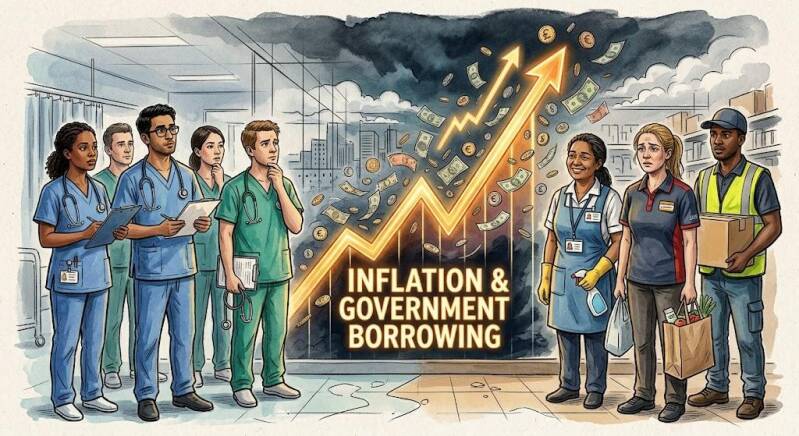
The Ripple Effect: How Healthcare Demands Impact the Lowest Paid
We all expect the medical profession to be the ultimate caring profession. We look up to doctors to put the health and wellbeing of others above all else. However, the conclusion of this long-running strike action through historic pay hikes forces us to look at the harsh realities of basic economics. The consequences are deeply concerning for our most vulnerable.
The Economics of Borrowing and Inflation
When the government bows to pressure and significantly increases pay for public sector workers like doctors, that money has to come from somewhere. Inevitably, the government ends up borrowing more or increasing the overall money supply.
Basic economics teaches us that pumping more money into the system without a corresponding increase in productivity creates inflation. When inflation rises, the cost of living goes up for everyone, from the price of a weekly food shop to utility bills and fuel.
Tracking the Widening Gap: Doctors vs. Minimum Wage Earners
To fully understand the societal impact, we must contrast the 35% cumulative increase secured by resident doctors with the actual trajectory of the UK National Living Wage over a similar four-year timeline.
While the lowest-paid workers have seen statutory steps to keep up with immediate inflation, their baseline trajectory fails to provide the compounding purchasing power handed to high-earning medical professionals:
- Resident Doctors: Secured a massive cumulative salary increase of 35.0% over the four years.
- National Living Wage Workers: Received a lower cumulative hourly increase of 33.7% over the same four-year period.
While these raw percentages look mathematically close on paper, the real-world cash gap has expanded drastically. A percentage increase on a doctor's starting salary of roughly £40,000 creates vastly more disposable capital than the same percentage applied to a minimum wage worker earning roughly £24,700 a year. The broader economic burden is inadvertently shifting onto those who can least afford it.
A Disconnect from the Real World
It makes you wonder if those in the medical profession have truly considered the downstream consequences of their actions. While the end of the strikes brings relief to the NHS, the broader economic shifts carry bizarre consequences. Many low-wage workers are realising that, once you factor in the inflated cost of living and travel, they might actually be better off claiming state benefits than working demanding jobs in cafes or restaurants.
When there is no one left to serve doctors in restaurants because minimum wage staff have chosen to rely on benefits, perhaps they will finally pause and think about the societal consequences of their demands.
#PublicSectorPay #NHSPayDeals #NationalLivingWage #CostOfLivingImpact #EconomicInequality
Add comment
Comments