

Take a walk down any city street after dark. If you are a woman, your phone is likely gripped firmly in your hand. Your headphones are out. You are calculating the distance between yourself and the person walking behind you.
Recent headlines paint a grim picture. According to data published by Plan International UK, millions of young women live with the daily reality of street harassment. Meanwhile, personal safety apps report massive surges in usage as women map out safer routes home.
This raises a heavy question: Are women increasingly terrified to exist in society, or have we fallen victim to a hyper-magnified, perceived fear?
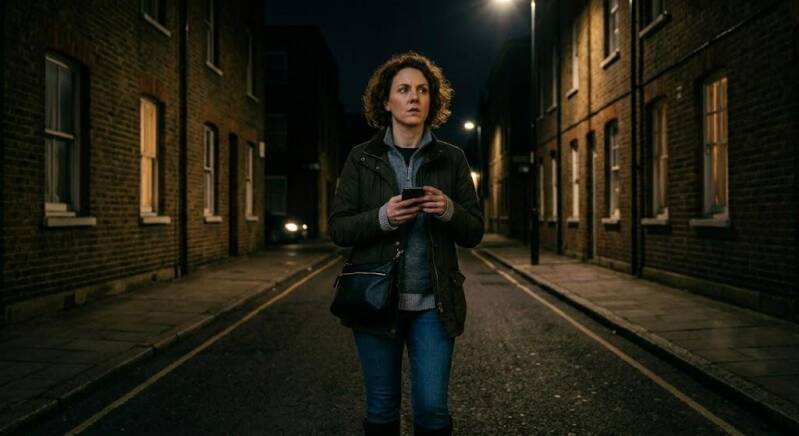
Criminologists and sociologists call this friction the ‘gender-fear paradox’. To understand what is truly happening, we have to look at the data, the invisible tax women pay to navigate the world, and the severe institutional failures that have broken public trust.
The Argument for ‘Perceived Fear’: The Gender-Fear Paradox
For decades, traditional crime statistics have presented a puzzling contradiction. Statistically, young men are significantly more likely to be victims of violent crime in public spaces than women. Yet, in survey after survey, women report vastly higher levels of fear and anxiety about being out in public.
Those who argue that the fear is largely perceived point to several modern catalysts:
- The 24/7 Digital Echo Chamber: True crime podcasts, viral TikTok warnings, and algorithmic news feeds push horrific stories directly to our screens daily. This constant exposure creates the illusion that danger is waiting around every single corner, even if local crime rates are steady or falling.
- Media Distortions: Public violence against women is heavily publicised. While these cases are deeply tragic, their intense media saturation can make rare, worst-case scenarios feel like daily mathematical certainties.
- The Hyper-Vigilance Trap: From a young age, women are conditioned to believe they are inherently vulnerable. This socialisation creates a baseline of anxiety that interprets everyday public spaces as hostile environments.
From a purely clinical, statistical standpoint, a woman's objective probability of being attacked by a stranger in a park remains low. If we look only at those numbers, the fear looks disproportionate.
The Reality: Why ‘Perceived’ Fear is Real Fear
To dismiss this fear as a mere trick of the mind completely misses the lived reality of being a woman. Criminologists have updated their understanding of the paradox by highlighting two critical factors: the shadow of sexual assault and the normalisation of low-level harassment.
- The ‘Shadow’ Offence
For women, the fear of property damage or a minor physical scuffle is rarely the primary concern. Instead, almost every public fear sits under the ‘shadow of sexual assault’. A poorly lit street or a stranger walking too close triggers a deep-seated biological alarm because the stakes—sexual violence—are uniquely traumatic.
- The Constant ‘Low-Level’ Hostility
While statistical charts track major crimes like homicide and aggravated assault, they rarely track the daily, exhausting baseline of public harassment. Data cited by the Crown Prosecution Service (CPS) reveals that a staggering 71% of women in the UK have experienced some form of sexual harassment in a public space. Worse still, 95% of these cases go unreported to the police.
These are not ‘perceived’ threats; they are actual, regular occurrences. When a woman is subjected to these behaviours repeatedly, her body treats public space as an active risk zone. Her hypervigilance isn’t paranoia—it is a logical, learned defence mechanism.
The Migration Debate and the Clash of Cultures
The discussion around public safety becomes significantly more polarised when intersecting with immigration and cultural differences. There are two deeply entrenched perspectives on whether migration introduces a further layer of risk to women and children.
The Argument Regarding Imported Risk
Proponents of this view argue that immigration from countries with deeply patriarchal social norms introduces a distinct, imported risk to Western women. They point to data collated by groups like the Centre for Migration Control (CMC), which reports that foreign nationals are arrested for certain offences, including sexual crimes, at a higher rate per capita than British citizens. The concern is that a clash of cultural values regarding women's autonomy, consent, and public freedom directly undermines a woman's right to feel safe.
The Argument Intersecting Systemic Abuse
Conversely, criminologists and domestic abuse charities like Rape Crisis UK note that over 90% of violent and sexual offences against women are perpetrated by men already known to the victim (partners, ex-partners, or family members), rather than strangers or migrants in public spaces. Furthermore, advocacy groups like Southall Black Sisters emphasise that migrant women and children are actually at a disproportionately higher risk of suffering violence themselves, as abusers frequently weaponise insecure immigration statuses to keep them silent.
Institutional Betrayal: Grooming Gangs and the ‘Discourse of Disbelief’
The primary reason women’s fear has evolved from a general anxiety into deep-seated anger is a history of institutional failure. Public trust has been shattered by cases where authorities actively chose political correctness or bureaucratic convenience over child protection.
The Grooming Gang Scandals
The issue of group-based child sexual exploitation (CSE)—commonly known as grooming gangs—represents one of the greatest structural betrayals in modern British history. High-profile cases in towns like Rotherham, Rochdale, Telford, and Newcastle exposed a horrifying reality.
The landmark Jay Report revealed that social workers, police officers, and local council officials actively ignored or downplayed victims' claims for years because they were terrified of being accused of racism or sparking community tensions, given that a significant number of the prominent perpetrators in these specific networks were of British-Pakistani or Asian heritage. Young, vulnerable girls were dismissed as ‘risky adolescents’ while predators operated with near-impunity.
The Dundee Confrontation: A Case of Default Disbelief
This institutional instinct to doubt victims or downplay sensitive cultural headlines remains a major flashpoint today. A recent case in the Lochee area of Dundee, Scotland, perfectly illustrates what critics call the ‘discourse of disbelief’.
A viral video emerged showing a 12-year-old Scottish girl brandishing a weapon in a public street to protect herself and her sister. Police Scotland initially arrested and charged the 12-year-old for possession of offensive weapons. At the same time, officials cautioned the public against spreading ‘online rumours’ about the male involved—a 22-year-old foreign national named Ilia Belov.
However, when the case went to trial at Dundee Sheriff Court, the official scepticism was proven entirely false. The court heard that Belov had approached the children, making predatory, sexual remarks (‘hello sexy, I’ll show you a good time’). When they rejected him, Belov called his sister, who physically assaulted the 13-year-old girl, dragging her by the hair. The younger sister had armed herself entirely to protect her sibling from a violent predator. The Sheriff found Belov guilty of the assault, but the case left a lingering question: Why is the state's first instinct so often to disbelieve the victim?
Rhetoric vs. Reality: What has the Government Actually Done?
Historically, women have been told to modify their own behaviour to stay safe—don't walk alone, wear bright clothing, or carry your keys between your knuckles. In official statements from the Home Office on GOV.UK ministers have explicitly rejected this stance, declaring that making safety a woman's ‘problem to manage’ is unacceptable.
However, to judge whether the state is truly protecting women, we must look past speeches and divide the government's actions into two distinct categories: what is a physical reality on the ground, and what remains a mandated policy on paper.
-
What is PHYSICALLY Done (Realities on the Ground)
These are brick-and-mortar installations, active law enforcement units, and enacted laws that physically exist right now:
- Liverpool's "Halo Points": These are active, physical installations launched by Merseyside Police. Nine highly visible, well-lit safety pillars have been erected across Liverpool city centre, linking users directly to live emergency services and integrated CCTV.
- The Grooming Gang Taskforce (Operation Beaconport): Backed by record funding to tackle child sex abuse, this is an active law enforcement unit. The National Crime Agency and police forces have physically opened and actively re-investigated over 1,200 archived or improperly closed child sexual exploitation cases.
- Active Emergency Room Pilots: Domestic abuse specialists have been physically embedded directly inside emergency 999 control rooms across five pilot forces (including the West Midlands, Northumbria, and Bedfordshire) to immediately control dispatch when a woman calls under immediate threat.
- The Enactment of Law: The Protection from Sex-Based Harassment in Public Act is fully enacted law. Perpetrators are actively being arrested, prosecuted, and jailed for up to two years for public catcalling, following, or cornering women on the streets.
- Refuges & Safe Housing: Through statutory duties in the Domestic Abuse Act, local councils were allocated £19 million directly to guarantee physical, secure safe accommodation and emergency housing for survivors and their children.
-
What is ONLY ‘Mandated’ or Pending (Rhetoric & Guidelines)
These are ideas that have been ordered or written down on paper, but have not yet been built or integrated uniformly across the country:
- The Active Travel England Street Redesigns: This is currently a mandate, not a widespread physical reality. While the government announced nationwide urban design plans to eliminate blind spots, dark underpasses, and unlit shelters, the official design guidance and local council training sessions are slated for rollout throughout 2026. Most UK towns have yet to see their physical environments altered.
- National 999 Coverage for Raneem’s Law: While active in five pilot regions, the presence of specialists in every emergency room is still a mandated target. A full nationwide rollout across all 43 police forces in England and Wales remains a work in progress.
- The 10-Year Strategy to Halve VAWG: The statutory mission to halve violence against women and girls within a decade is a legal pledge. However, as watchdog groups point out, a pledge is a political commitment; its success depends entirely on long-term funding and consistent police enforcement over the next ten years.
- Mandatory Ethnicity & Nationality Tracking: Police forces have been legally ordered to record the ethnicity and nationality of all sexual abuse suspects to eliminate the historic ‘blindness’ caused by political correctness. However, independent audits show that data uniformity across all regional forces is still an unfulfilled administrative mandate rather than a flawless reality.
However, beyond physical and legal frameworks, critics argue that the government's foundational approach to women's safety is compromised by political correctness. Opponents frequently point out that a state cannot realistically protect women in society if top leadership, including the UK Prime Minister, has struggled under questioning to definitively define what a woman is, signalling to critics a deeper institutional confusion about women's unique sex-based protections.
The High Cost of the ‘Safety Tax’
Whether the threat is an imported cultural risk, a domestic partner, or an active grooming network, the consequences are incredibly tangible. Women pay a massive, invisible safety tax every day to exist in society:

The Bottom Line
Is women's fear of society growing? Yes. Is it just a perception? No.
The fear is a logical, protective response to a culture where low-level boundary violations are common, historical grooming scandals were covered up by authorities, and the threat of severe violence is a shadow that follows women everywhere. Labelling this fear as ‘perceived’ shifts the burden onto women to fix their mindsets, rather than forcing society to fix the environment.
With strict legislation like the Protection from Sex-Based Harassment in Public Act, mandatory ethnicity tracking, and the target to halve violence against women, the state is finally admitting a vital truth: the fear is justified, the environment is broken, and it is the state's job—not women's—to fix it. Until these physical policies and legal overhauls yield a real cultural shift on the streets, women will continue to look over their shoulders. And they have every right to do so.
Add comment
Comments