

At London Tech Week, British Prime Minister Keir Starmer delivered a striking ultimatum to Silicon Valley giants like Apple and Google: implement device-level protections to stop children from taking, sending, or viewing explicit images within three months, or face legislation that forces compliance.
‘When it comes to the safety of our children, standing by is not an option’, Starmer declared, aiming to make the UK the first country in the world to implement total device-level blocks for minors.
This announcement has rapidly accelerated a global debate. The core tension lies in a fundamental conflict: absolute digital privacy versus state-mandated child protection.

The Two Sides of the Screen
As the clock ticks toward the September deadline, the debate has split sharply between safety advocates and digital rights defenders.
-
Proponents: A Vital Shield Against an Epidemic
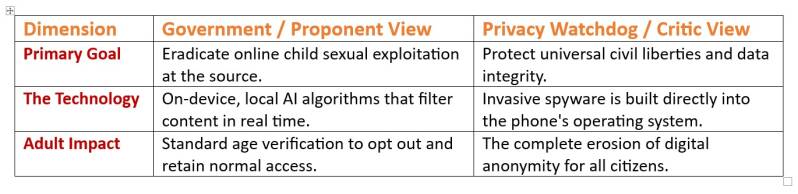
For the Government, the Home Office, and prominent charities like the NSPCC, this mandate is a practical tool to combat an epidemic of digital child grooming and self-generated abuse material. Proponents emphasise that:
- Privacy is respected: Local, on-device scanning utilises automated nudity-detection algorithms. No data, messages, or images leave the device to be monitored by state authorities.
- Tech companies have a moral duty: Tech giants possess the world's most advanced innovation infrastructure. They have the technical means to implement these filters seamlessly at the operating system level (iOS and Android).
-
Critics: A ‘Trojan Horse’ for Mass Surveillance
Conversely, digital rights groups, privacy watchdogs like Big Brother Watch, and encrypted platform operators have raised immediate alarms. They view the policy as a dangerous ‘Trojan Horse’ for mass surveillance, arguing that:
- Privacy is broken: Building mandatory scanning architecture fundamentally breaks the principle of absolute end-to-end privacy and violates the right to a private life.
- Collateral intrusion: To distinguish between a child's device and an adult's device, the mandate will require invasive, sweeping age-verification systems for adults across the entire population.
The Broader Societal Impact
The UK's approach reflects a growing global challenge. Governments are aggressively trying to regulate encrypted, digital spaces to police crime, while tech companies and civil liberties groups fight to keep consumer devices entirely private.
What Happens Next?
The tech industry's three-month window is more than just a regulatory deadline—it is a countdown to a massive legal and technological showdown. If Apple and Google resist, the ensuing UK legislation could trigger heavy corporate fines and criminal liability for senior tech executives.
Ultimately, the outcome of this three-month ultimatum will likely set a major global precedent. It will define how democratic societies balance digital human rights with public safety for decades to come.
Add comment
Comments