

The contrast playing out in the English Channel provides a stark lesson in political priorities and state capability.
On the one hand, the British state just proved it can execute a flawless, high-stakes military operation on the open seas. Royal Marine Commandos fast-roped from helicopters under the cover of darkness to seize the Smyrtos, a massive Russian ‘shadow fleet’ oil tanker. Guided by the Prime Minister’s orders to choke off funds for the war in Ukraine, our elite forces and National Crime Agency (NCA) officers successfully boarded and detained a sanctioned vessel in international waters.
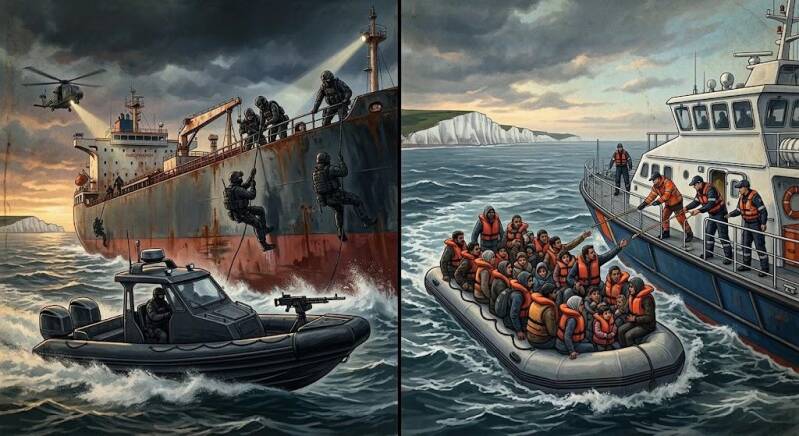
The operation was a masterclass in military precision. Yet, it leaves everyday observers asking a glaring, uncomfortable question: If the British military can stop a commercial oil tanker, why does it remain completely powerless against a fleet of rubber dinghies crossing the exact same strip of water?
Power vs. Powerlessness: The Maritime Paradox
The successful seizure of the Russian tanker proves that the issue has never been about a lack of hardware, tracking technology, or elite personnel. The UK possesses the naval and aerial assets to locate, intercept, and board moving vessels in the Channel at will.
When it comes to national security or international sanctions, the state moves with absolute authority, but when defending the UK’s borders against the relentless influx of illegal small-boat crossings, the entire system seems to grind to a halt.
While commandos are clearing the decks of foreign tankers, migrant dinghies continue to land on the beaches of Kent, often escorted safely to shore by the Border Force and Coastguard rather than being turned back.
The Legal Double Standard
The disparity boils down to political will and legal frameworks. The government actively sought and used a legal basis under international law to justify boarding and detaining the Smyrtos. They treated the shadow fleet as a clear and present threat to international stability that required immediate, aggressive intervention.
However, when dealing with small boats, the government consistently hides behind a web of human rights legislation, asylum laws, and maritime safety regulations. The official argument is that turning back or physically stopping rubber dinghies risks lives in the water, converting a border enforcement issue into a search-and-rescue mandate.
But to the ordinary taxpayer, this excuse is wearing incredibly thin. It creates a bizarre reality where the state has the teeth to confront a hostile nuclear superpower on the high seas, but lacks the legal or political spine to secure its own coastline from human traffickers.
Could the Crew Now Claim Asylum?
The short answer is yes. The Russian crew could legally apply for asylum. Under UK and international law, once any foreign crew member is brought onto UK soil or into British territorial waters under the control of UK forces, they have the legal right to claim asylum. In the case of the Smyrtos, the 24 Georgian and Indian crew members now fall under British jurisdiction. If they can prove a legitimate fear of retaliation or persecution upon being sent back, the UK government could find itself entangled in a complex legal battle—a specific loophole that ministers reportedly worried about before greenlighting the operation.
A Question of Priorities
The optics of this week’s events are deeply damaging to public trust. It sends the message that the government considers enforcing foreign oil sanctions a higher priority than the integrity of domestic borders.
Securing the Channel against small boats is not a question of military capability; it is a question of political choice. If the Royal Marines can take control of an ocean-going vessel under the nose of the Kremlin, the state can find a way to halt the rubber dinghies. Until the same level of legal aggression and tactical resolve is applied to the small boats crisis, the British public will continue to watch millions spent on grand geopolitical gestures while our own borders remain an open door.
What are your thoughts?
Does the seizure of the Russian tanker prove that small boat crossings could be stopped if the government had the political will? Or are the legal and humanitarian challenges of small boats truly incomparable? Let me know in the comments below.
#NationalSecurity #ShadowFleet #MaritimeLaw #BorderControl #PublicPolicy
Add comment
Comments