

The debate surrounding young people, mental health, and the internet has officially reached Downing Street. In a highly publicised press conference from Downing Street, Prime Minister Sir Keir Starmer announced a sweeping, Australia-style ban prohibiting under-16s from accessing major social media platforms like TikTok, Instagram, and Snapchat.
During his speech, Starmer struck an emotional and uncompromising tone, stating:
‘I am not prepared to compromise on the safety and happiness of our children... Social media is making children unhappy. I’ve heard first hand from families crying out for change, and we will do right by them’.
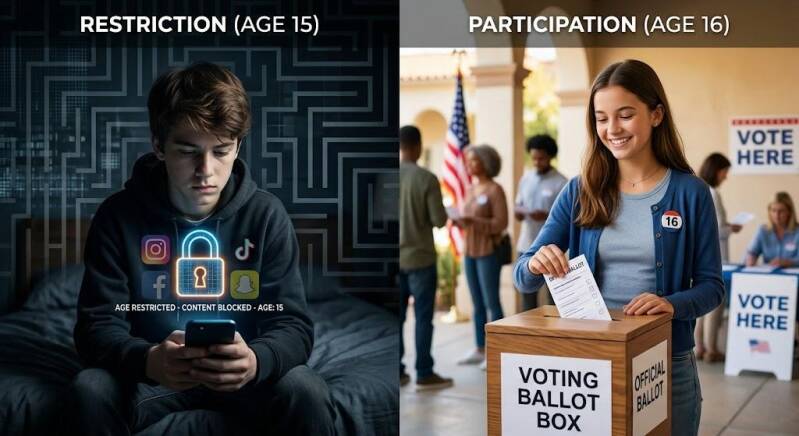
While every parent and citizen wants children to be safe, a targeted ban is a blunt instrument for a nuanced problem. It creates a baffling political paradox and ignores the failure of the exact policy it is trying to copy.
The 16-Year-Old Paradox: Mature Enough to Vote, Too Immature for a Smartphone?
The most glaring flaw in the government’s logic is the stark contradiction in how they view young people’s maturity.
On the one hand, the Labour government has vigorously championed lowering the voting age, arguing that 16- and 17-year-olds are mature, politically engaged, and responsible enough to help decide the future of the country. They are old enough to pay income tax, join the armed forces, and choose the lawmakers who govern them.
Yet, under this new policy, a 15-and-a-half-year-old is deemed so entirely lacking in digital literacy and resilience that they must be legally barred from many social media sites. How can we argue that a teenager is on the cusp of democratic capability and fighting for our country while simultaneously treating them as entirely helpless in the face of an algorithm?
The Warning from Down Under: Australia’s Failed Experiment
The UK is pitching its strategy as an ‘Australia-plus’ model. But if ministers actually looked closely at Australia’s blanket ban, they would realise it is an operational failure.
Data emerging from Australia shows that sweeping prohibitions simply do not work. Studies and age-verification trials have shown that up to 78% of children continued to access banned platforms like Instagram and TikTok anyway. Furthermore:
- 41% of children admitted to deliberately subverting the ban via VPNs, fake dates of birth, or alternative accounts.
- 43% of parents admitted they were fully aware their kids were bypassing the system.
Instead of protecting children, the Australian ban merely pushed tech-savvy teenagers into unregulated, darker corners of the web or forced them to lie. A blanket ban creates a false sense of security for parents while doing nothing to stop the underlying behaviour.
Regulation, Not Isolation: A Smarter Way Forward
There is immense room to control, clean up, and strictly regulate social media content for young people. Nobody is arguing for a digital Wild West. But the onus must be placed heavily on the multi-billion-pound tech companies, rather than a heavy-handed state ban from popular social media platforms.
Instead of an outright ban, a successful digital safety policy should focus on:
- Algorithmic Accountability: Banning addictive ‘infinite scroll’ mechanics and predatory ‘rage-bait’ algorithms for minors.
- Strict Content Curation: Forcing tech companies to filter out harmful, explicit, or deeply toxic feeds for verified younger accounts.
- Curfews and Feature Controls: Disabling toxic features—like direct messaging from strangers or late-night push notifications—rather than deleting the app entirely.
Bottom Line
By entirely cutting off under-16s, the government risks isolating vulnerable youth who rely on online spaces for community, minority support, and digital education.
We need to teach young people how to navigate the digital world safely, not pretend we can lock them out of it. If 16-year-olds are mature enough to shape our democracy at the ballot box, our 14-and 15-year-olds are capable of learning how to use the internet responsibly—provided the government forces Big Tech to clean up its act.
#DowningStreetPressConference #Bansocialmediaforunder16 #Australiancase
Add comment
Comments