

When I walk through our streets today, I cannot help but feel a profound sense of alienation. We are living through one of the most rapid demographic and cultural transformations in our history, and the reality is that our streets are becoming unrecognisable. Our traditional customs are dissipating to the point where the historic indigenous population is becoming the minority in its own urban centres, and our children can no longer play freely outside the way they used to.
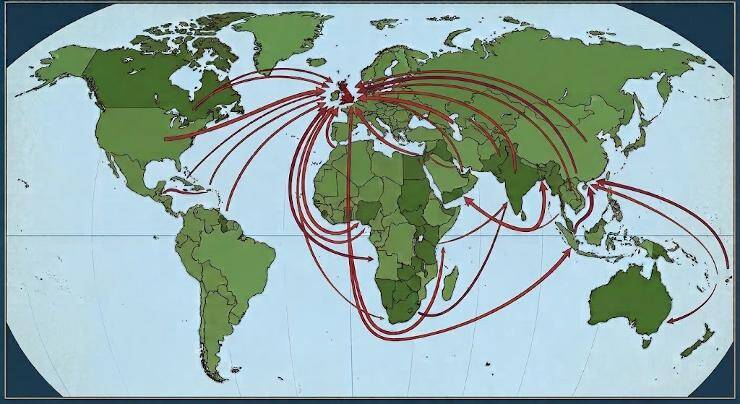
To make sense of what I am witnessing, I find myself looking back at a provocative historical parallel: the British Empire. We all know the history of how our country expanded across the globe and invaded other nations centuries ago. But when I hold that history up against what is happening to us right now, I see a mirror. I look at our uncontrolled immigration, the shift in our spiritual landscape, and the institutional changes taking place, and it forces a challenging question: Are we experiencing a modern form of reverse colonisation?
To understand why I have thought this, we have to look at the mechanics of past colonialism and compare them directly to our life today.
The Displacement of Faith and Tradition
Perhaps the most visible sign of this shift is the changing religious landscape of our towns and cities. Entire neighbourhoods are now dominated by alternative places of worship, while traditional parish churches increasingly sit empty or are repurposed.
I see a direct parallel here to what the British Empire did when it colonised other nations. Historically, when British administrators and missionaries arrived in places like India, Africa, or the Middle East, they brought Christianity with them. Over generations, they built churches, established mission schools, and used their institutional power to displace or marginalise indigenous religions and spiritual traditions. Today, we are seeing the exact opposite happen on our own soil. The historic faith of this country is being pushed to the margins as alternative religions gain institutional dominance at the highest levels.
This institutional retreat reaches the very apex of the constitutional system. The monarch serves as the Supreme Governor of the Church of England, yet the Crown's modern spiritual mandate has undergone a quiet but profound shift. King Charles III has long championed a pluralistic approach, famously stating his desire to be a protector of faith in general within a multi-faith nation. When the Crown itself pivots from its singular historic duty—hosting official Islamic Iftar events at royal residences—it signals a top-down transformation of traditional British identity. When the literal crown over our country steps back from defending Christianity, it signals a top-down abandonment of British identity.
Our local governments actively mirror this cultural erosion. We now see local councils that refuse to use the word "Christmas" when putting up festive lights during the holidays, opting instead for secular phrases like "Winter Lights" or "Festive Celebrations" so as not to cause offence. Yet, those same councils will openly and enthusiastically fund, promote, and celebrate other religious holidays in the public square. To me, this institutional double standard is clear evidence that the state is systematically phasing out our foundational heritage.
The Creep of Alternative Customs and Law
This religious shift feeds directly into the steady creep of alternative cultural practices and the operation of parallel legal frameworks—such as Sharia councils handling community disputes rather than actual courts. This feels like a modern mirror of historical colonial displacement.
In academic terms, this is called legal pluralism. Just as the British Empire allowed dual legal systems to maintain control in its colonies—leaving local family and religious matters to indigenous courts while holding top-tier authority—our modern authorities tolerate alternative systems under the banner of multiculturalism. For me, this completely undermines the foundational principle of "one law for all."
This shift has entirely altered our physical and linguistic landscape. While the Empire once aggressively exported the English language and erected statues of Queen Victoria worldwide to cement its dominance, our streets are now a patchwork of foreign languages. At the same time, our politicians and institutions are actively pushing to "decolonise" our public spaces—renaming historic transport lines and re-evaluating traditional monuments. To me, it looks like a deliberate effort to archive and phase out our historic British identity.
Paid Benefits and the Breakdown of the Social Contract
A critical component of historic colonialism was economic exploitation. The Empire entered foreign lands to extract raw materials and wealth, funnelling those resources back to the mother country while utilising local populations for cheap labour.
Today, the economic argument has completely inverted. Uncontrolled migration is placing an unprecedented strain on our public infrastructure, housing, and the NHS. But for me, the core of the issue is access to state-funded welfare and paid benefits. Our public funds are being distributed to support this rapid influx, placing an unfair financial burden on the indigenous tax-paying population. It has fundamentally broken the traditional social contract of the welfare state. While mainstream economists argue that we need foreign labour to sustain an ageing population and fund public services, it feels like our own resources are being drained to support a system that no longer serves us.
A Total Collapse of Institutional Trust
Perhaps the deepest parallel I see is the total breakdown of trust between the population and the state. At the height of the Empire, colonised populations completely lost faith in law enforcement and the courts because those systems were seen as serving a distant, elite political class rather than protecting local people.
I believe we are experiencing that same crisis of institutional legitimacy today. We cannot trust our criminal justice system, we cannot trust our law enforcers, and we certainly cannot trust our politicians, who consistently lie and show zero commitment to protecting the indigenous population. The rise of perceived two-tier policing and the total failure to secure our national borders make it clear that the state has abandoned its fundamental duty to protect its core citizens. To me, this is the very definition of a societal collapse.
Final Thoughts: A Choice for the Future
When I think about whether these shifts represent historical "payback" or simply the natural evolution of global power, I see a profound historical cycle at play. Some people argue that modern demographic shifts are the inevitable legacy of empire—a form of historic retribution for what our ancestors did years ago. Others view it strictly as a standard historical cycle, where dominant empires expand, peak, and eventually see their own borders soften and their culture dissolve as global power dynamics rebalance.
But recognising this cycle is only the first step. When we look at our emptying traditional churches, neighbourhoods dominated by alternative places of worship, and local councils that actively replace Christmas lights with secular phrases, the reality becomes undeniable. Most concerning of all is that this retreat from our heritage goes all the way to the top, with the King himself quietly shifting his constitutional focus from defending the historic faith to managing a multi-faith space. The real question is whether we accept this top-down cultural and societal displacement as an inevitability, or whether we recognise it and actively fight against it. Navigating this future—whether through a democratic reassertion of our borders, demanding strict cultural assimilation, and protecting our Christian heritage, or allowing society to continue down this path—will decide whether our traditional way of life survives at all.
Add comment
Comments
Absolutely 💯 % Spot on and as you state the parallels to colonialism are shockingly similar, very well written and explained