

A truly unprecedented moment has just unfolded in British politics. For the first time since devolution began, Scotland, Wales, and Northern Ireland are all simultaneously led by pro-independence First Ministers. On Monday, September 14, 2026, John Swinney (SNP), Rhun ap Iorwerth (Plaid Cymru), and Michelle O'Neill (Sinn Féin) held a historic emergency summit in Cardiff to sign a joint pact declaring that "Westminster’s time is coming to an end”.
The nationalist leaders used the event to issue a blatant warning to Prime Minister Andy Burnham, with Swinney boldly predicting that Burnham will go down in history as "the final prime minister of the United Kingdom". They have seized on Burnham’s recent, highly controversial PMQs comments—where he accidentally implied that a Scottish referendum could happen under the right conditions—to demand immediate pathways to separation.
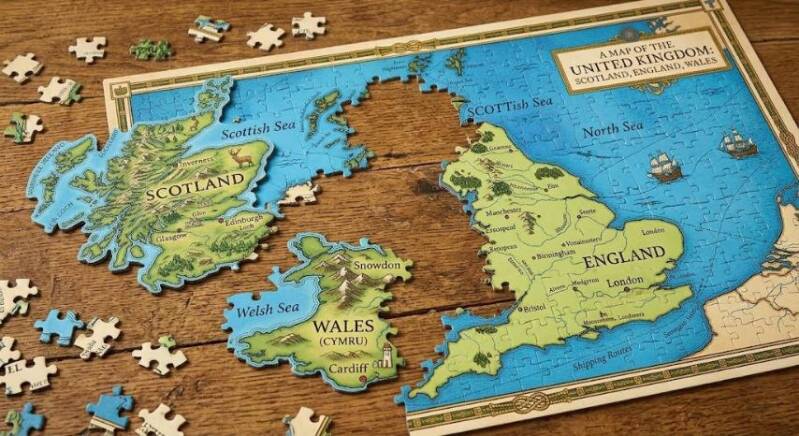
But despite the triumphant rhetoric echoing from Cardiff, there is a glaring, fundamental issue here: none of these ideologues have actually thought the hard economics through.
The blueprint signed by these leaders relies on a rapid exit from the UK to join the European Union. Yet, EU membership for these three breakaway nations is very much in doubt. Brussels is highly unlikely to roll out the red carpet immediately.
So, what happens when the umbilical cord to the rest of the UK is cut, and the EU shuts the door? Without British backing, these countries face a fast track to bankruptcy. They simply cannot answer the most basic question in politics: How are you going to pay for it?
The Reality of the "Independent" Nations
-
Scotland: Volatile Oil, High Debt, and Local Crisis
Nationalists will immediately point to North Sea oil and gas as Scotland’s economic saviour. However, the exact same people shouting the loudest for independence are also shouting the loudest for Net Zero—meaning they intend to kill off the very resource they claim will fund their new state.
Beyond that, Scotland would have to shoulder its massive share of the UK national debt, all while trying to navigate the fact that the vast majority of Scotland’s trade is with England. Severing that tie would complicate trade to a disastrous degree.
Look at how the SNP operates locally. Cities like Edinburgh and Glasgow are already under immense strain, particularly regarding housing shortages exacerbated by poorly managed migration policies. If a government cannot effectively manage its primary cities, it has no business trying to manage an entirely new country.
-
Wales: No Industry and a Lack of Public Appetite
The economic reality for Wales is even bleaker. There is very little big industry left to sustain an independent economy. In fact, the single biggest employer in Wales is the DVLA centre in Swansea—a UK government department that would inevitably be pulled back to England in the event of a split.
More importantly, despite Rhun ap Iorwerth’s sudden grandstanding in Cardiff, the vast majority of the Welsh public do not even want independence. They remain part of the Union because they know the alternative would be economically catastrophic.
-
Northern Ireland: A Public Sector Economy
Taking the independence argument to Northern Ireland forces a conversation about Irish unification—something the unionist population absolutely does not want, and an outcome that directly threatens the fragile balance of the Good Friday Agreement.
From a purely financial standpoint, Northern Ireland's economy is overwhelmingly dominated by the public sector. There is virtually no standalone industry to generate the revenue required to fund a modern state's infrastructure.
The Currency Conundrum
If these nations break away, what happens to the everyday systems we take for granted? What do they do without the British pound, the NHS, or the UK’s trade deals?
Because Brussels is highly unlikely to grant them immediate entry into the Eurozone, these new countries would find themselves completely without a viable currency. They could easily end up forced to adopt the US dollar at astronomical, ruinous conversion rates.
The Bottom Line: Hard Economics Wins
You can make all the emotional, cultural, and societal arguments for independence that you want. Ultimately, politics always comes down to hard economics.
Without the financial engine of the United Kingdom, an independent Scotland, Wales, or Northern Ireland would face soaring taxation, instant recession, and a public services nightmare. It is an identitarian concept that sounds grand when shouted from the rooftops of Cardiff Bay, but falls apart the second you look at the balance sheet.
Add comment
Comments