

A profound sense of anxiety is sweeping across the British working class. It is driven by the realisation that the traditional relationship between the citizen and the state is being systemically dismantled. In towns and cities across the United Kingdom, residents are watching the rapid decline of their high streets, the strain on local infrastructure, and a legal framework that appears increasingly indifferent to national sovereignty.
From the total failure of physical border enforcement to an economy that imports millions of workers for jobs that automation is rendering obsolete, the state of the nation reflects a deep-seated structural crisis.
The Realities of the Border Crisis: Safety Logistics vs. True Deterrence
The stark operational realities of the English Channel migrant crisis were laid bare following a major ruling at Canterbury Crown Court. Chan Atak, an asylum seeker from South Sudan, was sentenced to two years and three months’ imprisonment after piloting an overcrowded, deflating 14-metre dinghy across the English Channel.
The crossing set a dangerous new precedent, carrying a record high of 165 passengers packed into a vessel designed for a fraction of that size. The extreme danger of the 24-hour crossing was highlighted by critical mechanical failures, including a non-functioning engine, a heavily worn propeller, and a hull that required constant manual pumping mid-journey to prevent complete deflation.
The Judicial Disconnect
For the public watching these proceedings unfold, cases like Atak’s expose a frustrating disconnect within the British judicial system:
- The Illusion of Age Accountability: Public scepticism frequently arises regarding the recorded ages of arriving migrants. Observers consistently note that individuals presented in court often appear significantly older than their officially stated teenage status. Yet, the legal system routinely proceeds based on documented assertions, which can unlock specific sentencing leniencies or youth protections.
- Managing Symptoms Over Crime: Public anger demands severe, structural punishment for the act of illegal entry and the exploitation of national borders. However, the court’s focus is strictly bound by the parameters of the specific charge brought forward: "endangering others during a sea crossing."
- The Smuggling Loophole: Because both the prosecution and defence agreed there was no evidence Atak organised the smuggling ring or stood to make a profit (he claimed he paid €200 to a gang just like the other passengers), the judge could not sentence him as a human trafficker. The legal lens shifted entirely to the unseaworthiness of the vessel and the physics of the danger itself, treating a major breach of national borders as a maritime safety violation rather than an act of illegal entry.
While Atak’s custodial sentence technically makes him liable in principle to automatic deportation as a foreign national, the practical execution of such removals remains notoriously gridlocked by human rights appeals and systemic backlogs.
The Economic Disconnect: Importing Labour in the Age of AI
The political justification for mass immigration has long rested on a specific economic narrative: the UK must continuously import millions of foreign workers to maintain a strong economy, fill labour shortages, and support an ageing population. However, this policy is colliding with a massive structural shift in the global workplace.
The state is encouraging large-scale migration at the exact moment when artificial intelligence (AI) and advanced automation are reorganising the labour sector. The low-skilled, entry-level, and administrative roles that historically absorbed large numbers of workers are rapidly disappearing. Instead of fuelling high-productivity growth, mass migration is being used as a short-term plaster for a stagnant system. The result is a severe economic mismatch: the government is importing an endless supply of labour for jobs that technology is actively destroying.
From Global Policy to High Street Decay: The "Hope Tax"
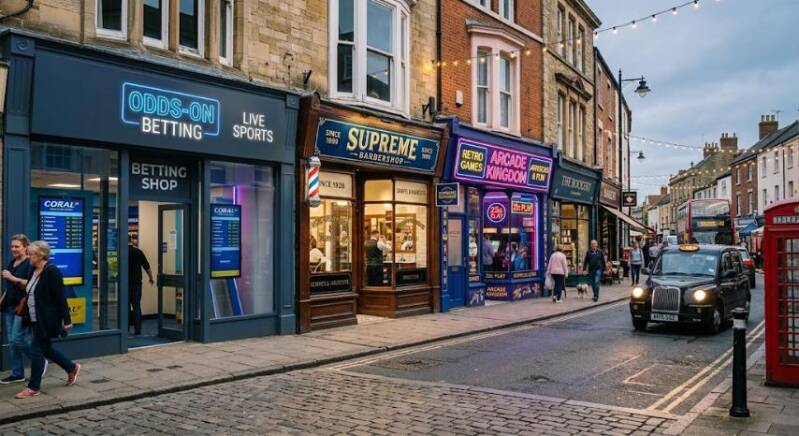
The painful consequences of this economic mismatch are felt most acutely on the frontline of Britain's working-class communities. Rather than the promised fruits of a booming, high-tech economy, local town centres have been reduced to a visual baseline of economic stagnation. Traditional retail has collapsed, replaced by a visual monopoly of shuttered business units, an explosion of cash-in-hand barbers, and endless nail bars.
Interspersed between these low-tier service shops is a predatory surge in betting shops and amusement arcades. It is here that the disconnect between the government's rhetoric and reality becomes clearest, as vulnerable residents face what can only be described as a "hope tax". Cut off from real economic opportunity, people pour their remaining money into betting machines, or gamble on horses and football matches, in the fleeting hope of winning a life-changing sum. It is an outcome they rarely achieve.
Yet, this cycle serves a dual purpose for the establishment: it keeps a disenfranchised population distracted, while the government consistently extracts lucrative tax revenues from the gambling corporations enabling it. As these rapid socio-economic changes occur alongside rising anti-social behaviour and public vagrancy, native communities are left paying high rates into a system that no longer reinvests in their local environment or safeguards their way of life.
The Erosion of Free Speech and the Censorship Threat
As the social and economic strains of this policy become impossible to ignore, public frustration is increasingly met not with political solutions, but with legal suppression.
A central grievance among the native working-class population is the systemic policing of language. While local communities bear the immediate brunt of rapid demographic shifts—including rising anxieties over public safety and anti-social behaviour—citizens are explicitly told by state authorities to remain silent.
Under the guise of tackling "hate speech", the threshold for state intervention has shifted dramatically. While academic institutions and elite commentators are permitted to discuss demographic data in abstract, clinical terms, ordinary citizens who voice their complaints in raw, non-academic language face immediate state scrutiny, police investigations, and potential arrest. This asymmetric enforcement creates a climate of fear, where defending the traditional identity, flags, or safety of one's neighbourhood is treated by the state apparatus as an inherently malicious act.
Final Thought: The Collapse of Social Capital
The current state of affairs represents a deliberate pivot away from national cohesion toward a globalist framework. Critics argue that the political establishment has decoupled itself from the interests of the domestic population, prioritising abstract metrics of "global equity" over the safety, continuity, and prosperity of working-class areas.
When a state cannot secure its physical borders, legalises the prosecution of its own citizens for speech, and systematically devalues the concept of national citizenship, it erodes its own legitimacy. A nation is not merely a geographic housing unit or an economic theme park for the world; it is defined by the distinct people, culture, and shared heritage that built it. Left unchecked, the systematic harvesting of Britain's social and financial capital guarantees a permanent transformation—one that leaves the country fundamentally fractured.
Add comment
Comments