

The British political landscape is fracturing in ways that our traditional first-past-the-post system was never built to handle. For decades, Westminster relied on a predictable two-party dynamic—a swinging pendulum between Labour and the Conservatives. Today, that pendulum has snapped.
The latest multi-level regression and post-stratification (MRP) model reveals a parliament so profoundly hung that it would turn Downing Street into an administrative nightmare. The numbers present a striking paradox: an electorate deeply dissatisfied with every mainstream option, resulting in a mathematical gridlock where neither the traditional left nor the right blocks can easily find a path to a 326-seat majority.
The Blueprint of a Super-Hung Parliament
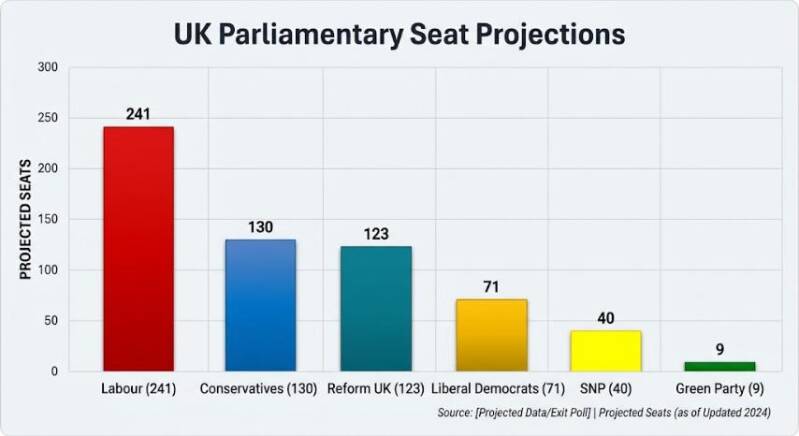
The headline seat projections from the YouGov MRP model present a radical departure from the traditional political landscape. To form a majority government in the 650-seat house, a party must cross a threshold of 326 seats. The latest data shows that every major party falls drastically short of this target:
- Labour: 241 seats (leaving them 85 seats short of a majority)
- Conservatives: 130 seats
- Reform UK: 123 seats
- Liberal Democrats: 71 seats
- SNP: 40 seats
- Green: 9 seats
On paper, Labour occupies first place. Yet, finishing with just 241 seats leaves them entirely unable to govern alone.
The popular vote tells an even more chaotic story. In terms of raw percentages, the top three parties are clustered tightly in the early 20s, with Reform UK actually edging ahead of the Conservatives into second place nationally.
The fact that Reform can beat the Tories in raw votes but still finish third in seats highlights the brutal geography of British elections. The Conservative vote remains highly "efficient"—meaning it is concentrated heavily in specific, winnable strongholds. The Reform vote, conversely, is spread thin across the entire country, diluting its impact.
The Tactical Dilemma: Why a Wasted Vote is a Country Ruined
This fragmented data means that when polling day arrives—whether for critical local council seats or a nationwide general election—sitting at home is not an option. The electorate must show up and cast their ballots, but they must think with absolute precision before doing so.
In this hyper-fractured environment, a well-meaning vote can easily become a wasted vote. Casting a ballot for a minor fringe party, or a candidate with virtually zero statistical chance of winning in your specific constituency, is a luxury the country can no longer afford. If voters do not look realistically at who actually has a path to victory locally, they inadvertently hand power to the very blocks they oppose.
Failing to vote tactically goes far beyond localised seat shifts; it opens the door to a chaotic multi-party coalition. A coalition government is the ultimate recipe for national decline. When minor parties hold a prime minister hostage, the vital priorities of the nation are traded away for backroom political survival.
The Mechanism of Decline: Vetoes, Borrowing, and Broken Borders
To understand why a coalition is so dangerous, we have to look at the structural mechanics of how governments actually function. A multi-party state creates an environment where compromise directly triggers national decline.
First, consider border security. Effectively managing border enforcement and stopping illegal small boat crossings requires swift, undivided executive power. In a coalition, however, a larger party's security policies must be filtered through minor partners who may hold completely different ideological viewpoints. If a smaller, more liberal coalition partner threatens to pull out and collapse the government over strict enforcement measures, the prime minister is instantly politically blackmailed. The result is total legislative paralysis, a complete standstill in enforcement, and a border security framework that completely breaks down because the boats simply will not be stopped.
Second, multi-party governments inherently drive economic bankruptcy. In a single-party majority, a Chancellor has the authority to enforce strict spending limits. In a coalition, stability must be bought. To secure enough votes to pass basic financial legislation, the leading party must indulge in "logrolling"—funding the expensive pet projects, green initiatives, or welfare expansions of their junior partners.
With official Office for National Statistics data confirming that UK public sector net debt is already sitting at £2,985.5 billion—stubbornly hovering just under the £3 trillion mark—adding uncontrolled coalition expenditure will drive the nation's finances over a cliff.
Finally, as national borrowing spirals out of control to keep political factions happy, the interest payments on that debt skyrocket, consuming money that should be funding frontline public services. When state funds are eaten up by debt servicing and bureaucratic logjams, baseline public services rapidly drop. Essential networks like the NHS, social care, and local infrastructure collapse under the strain. Crucially, national security and public safety drop as policing and defence budgets face freezes or cuts. The nation is left in absolute dire straits, vulnerable from without and decaying from within.
The Managerial Trap of the "Good Boss"
This threat of structural paralysis occurs against the backdrop of a changing Labour leadership. Following an era defined by deep unpopularity and alienation on both the left and right wings, Labour has experienced a modest rebound under Andy Burnham. But this bounce is fragile, driven more by the absence of a universally disliked predecessor than by a groundswell of genuine enthusiasm.
Burnham’s political style increasingly mirrors David Brent: the classic office manager who desperately craves validation as the "good boss". There is an undeniable cringe factor to his public presentation—the carefully curated "everyman" persona who peers down the camera lens, offers a knowing nod, and drops highbrow jokes to prove he is "down with the kids".
His recent pitch to allow alcohol back into the stands at football matches is a textbook example of this superficial branding. It is a policy designed entirely to burnish his image as a relatable, match-going football fan, rather than to shift the dial on any of the serious structural crises facing the country. Like the office manager trying to win over the team by relaxing the dress code, it does little to mask the underlying lack of a transformative national vision, but does everything to risk reigniting the football hooliganism that forced the ban to be introduced in 1985.
The Coalition Maths and the Sovereignty Trap
Because the electorate does not feel genuinely represented by any single party, the MRP numbers look less like a traditional British result and more like an unintended outcome of Proportional Representation. This creates an impossible puzzle for building a stable government. If we group the parties into ideological blocks, neither side can naturally govern:
- The Left Block: A combination of Labour and the Liberal Democrats yields 312 seats—still 14 seats short of a majority. Even throwing the Green Party into the mix leaves the block stranded at around 321 seats.
- The Right Block: An alliance of the Conservatives and Reform UK reaches just 253 seats, which is nowhere near the finish line.
To form a government, any Labour leader would be forced to look to nationalist parties, most notably the SNP's 40 MPs. But the price of Scottish or Welsh nationalist support would inevitably be a second independence referendum—a condition that transforms a Westminster coalition from a partnership into a constitutional hostage situation. The next parliament may well find itself defined not by an ideological struggle between progressives and populists, but by a bitter battle between unionists and separatists.
The Fragmentation of the Right and the Rise of the 'Quiet' Right
While Labour struggles with a lukewarm managerial identity, the right-hand side of the spectrum is locked in a fierce, multi-directional civil war. Reform UK’s previous dominance in the polls has eroded, not because its voters have suddenly fallen back in love with the establishment, but because its coalition is fracturing in opposite directions.
Recent political scandals have damaged Nigel Farage’s personal popularity, making traditional conservative voters highly reluctant to vote tactically for Reform. Instead, a significant portion of the anti-immigration, anti-establishment vote is being cannibalised by the emergence of the "Restore" party.
Intriguingly, focus groups reveal that voters are turning to Restore because they perceive it as a less vulgar, less extreme alternative to Reform. As a result of this split on the right, high-profile figures entrenched in Tory-adjacent seats find their positions structurally compromised by a divided base.
The Welfare State as a Political Weapon
In response to this squeeze, the Conservative leadership has attempted to shift the battlefield toward welfare reform—an issue that now rivals immigration in the public consciousness. Kemi Badenoch’s recent proposals to block the long-term unemployed from spending state benefits on alcohol and cigarettes represent an attempt to introduce a strict "contributory principle" back into the welfare state.
Under this framework, full Universal Credit would be reserved for those who have consistently paid into the system, while long-term or younger unemployed individuals would be relegated to a subsistence allowance distributed via a restricted card valid only for food and essentials.
While the rhetoric of cutting the national benefits bill plays well to a squeezed taxpayer base, the political reality is far trickier. The welfare bill touches a vast swath of the middle class through disability and mobility allowances, making blanket cuts deeply unpopular.
The public support for welfare cuts is highly specific: voters are generally only willing to see entitlement reductions targeted at migrants or the young. By structuring welfare reform around a lifetime contribution model, the Conservatives are deliberately protecting older voters—where their core electoral support is concentrated—while loading the entirety of the financial pain onto a younger generation that has not yet had the years to pay into the system.
A Nation Unrepresented
Ultimately, this mega-poll reflects a country experiencing a profound crisis of representation. A clear majority of the public does not believe that any political party understands their concerns or possesses the capacity to deliver meaningful change.
We are left with an electorate that must realise the absolute necessity of strategic voting. Failing to show up or wasting a vote on low-opportunity factions will result in the very coalition chaos that destroys national stability. Whether it is an office-manager style Labour leadership offering superficial culture wins or a fractured right trying to navigate generational welfare warfare, Westminster is out of sync with the public mood. If voters do not choose wisely and cleanly, the next resident of Downing Street won't just inherit a difficult parliament—they will govern a nation in freefall.
Final Thought: The Cost of Complacency
The true takeaway of this latest data is that Britain can no longer afford the luxury of protest voting or political apathy. When voters treat elections like a low-stakes opportunity to register dissatisfaction, they inherit a high-stakes crisis of governance. A hung parliament isn’t just a statistical quirk; it is a mechanism that paralyses the state.
If the public continues to atomise their votes into tiny, unworkable ideological corners, the resulting coalition architecture will accelerate the decline of our economy, our borders, and our security. The electorate must grow up faster than the politicians, or face the consequences of a country left entirely rudderless.
Add comment
Comments