

When teachers use the classroom to promote their personal political ideologies, they risk breaching one of the fundamental principles of British education: political impartiality. Sections 406 and 407 of the Education Act 1996 establish clear duties to prevent partisan political indoctrination and ensure that pupils encounter a balanced presentation of political issues.
Britain is not an authoritarian one-party state in which education is expected to reinforce a government-approved political ideology. In a free and democratic society, the purpose of education should be to equip children with the knowledge, reasoning skills and independence of thought to reach their own conclusions — not to mould them into supporters of their teachers' political convictions.
Political impartiality is not an optional extra. It is an essential part of professional teaching and a safeguard for the intellectual freedom of the next generation.
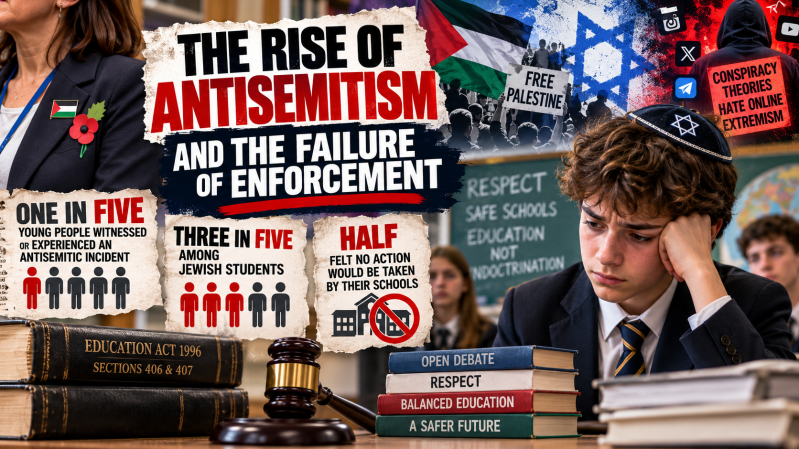
The Rise of Antisemitism and the Failure of Enforcement
The dangerous real-world consequences of letting politics seep into schools have been laid bare by a major independent review led by Sir David Bell. Investigating the extent of antisemitism in schools and colleges, Sir David’s findings are a stark wake-up call for the education sector:
- A Spike in Incidents: One in five young people surveyed witnessed or experienced an antisemitic incident, a figure that surges to three in five among Jewish students.
- A Culture of Silence: Perhaps most concerning of all, half of the young people affected felt that no action would be taken by their schools, leaving them disinclined to even report the prejudice they faced.
- Hostile Environments for Staff: Antisemitism is not just a peer-to-peer issue. The report revealed that Jewish teachers are encountering hostile atmospheres within their own staffrooms and schools.
While mainstream educational unions have a long history of tackling racism, the report highlights a critical failure in treating antisemitism with the same urgency. For too long, generic commitments to fighting "prejudice" have swept the problem under the carpet. Antisemitism must be recognised, recorded, and acted upon as a distinct, unique form of hatred.
The Problem With Badges and Political Symbols
The recent controversy surrounding teachers wearing pro-Palestinian symbols—and reports of a newly invented "Palestinian poppy"—has brought the debate over classroom dress codes to a head.
While some argue for outright legislative bans, the truth is that laws against politics in schools have already existed for a very long time. The issue isn't a lack of rules; it's a profound failure of institutional leadership and enforcement. Introducing a never-ending cycle of new laws only confuses the public and masks the real problem. What we need is fewer, clearer rules that are strictly enforced the moment a line is crossed.
When an individual in a position of authority stands at the front of a classroom wearing a highly charged political symbol—whether pro-Palestine or pro-Israel—it creates an immediate "chilling effect". How can a student feel safe to debate, discuss, or voice a dissenting opinion when their teacher is visibly flying a political flag? Teacher professionalism dictates that personal biases are left at the school gates so that students feel genuinely free to explore complex geopolitical issues.
Fuelled by the Fringes: The Left, the Right, and Online Conspiracies
When examining where this rising tide of classroom tension originates, it is clear that the blame cannot be pinned on one side of the political spectrum. Sir David Bell’s review found that antisemitism and political extremism are being incubated across both the left and the right, heavily fuelled by online conspiracy theories.
These toxic internet narratives are actively seeping into the consciousness of children, presenting an incredibly tough challenge for educators. However, the solution is not to ban difficult conversations entirely. To tackle these prejudices at their root, schools must facilitate open, robust debates—but they must do so within a framework of mutual respect, careful language, and absolute teacher neutrality.
Restoring the Purpose of Our Schools
If we are to fix the current trajectory of our education system, school leaders and unions must find the courage to challenge political bias and prejudice wherever they find it. Teachers are there to open minds, not close them. By enforcing existing rules, ensuring zero tolerance for distinct harms like antisemitism, and keeping political symbols out of the classroom, we can ensure our schools remain safe environments dedicated entirely to learning.
A Final Thought
Ultimately, protecting classrooms from political bias is not about censoring difficult world events; it is about protecting the sanctity of childhood curiosity. When educators trade objective teaching for personal activism, they rob students of the chance to develop their own critical thinking skills. Our schools should be the training grounds for independent minds, not the echo chambers for adult ideologies. To secure a fair and democratic future, we must ensure that when a child walks through the school gates, they enter a space of universal possibility, not pre-determined indoctrination.
Add comment
Comments