

This was a Budget for getting by, not for getting on
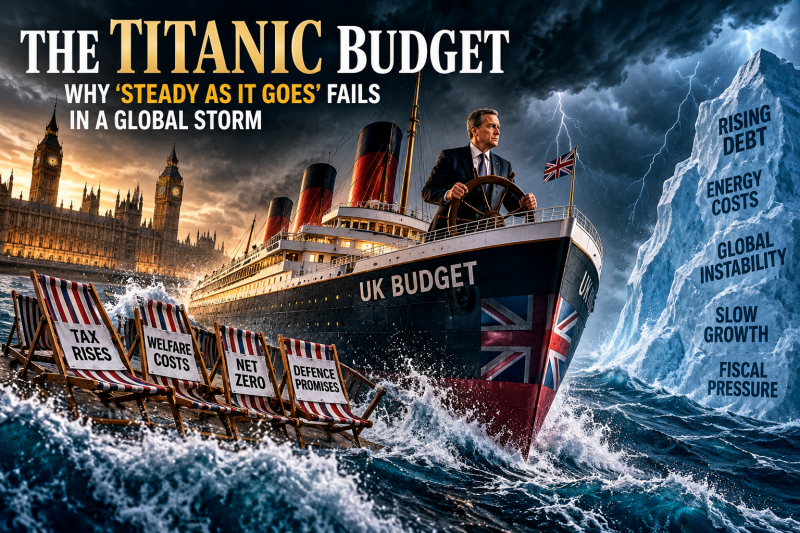
Chancellor John Healey loves using nautical metaphors about steering Britain through a global economic storm. But let’s be honest: maintaining course isn't exactly reassuring when the ship is already taking on water.
With sky-high public debt, weak productivity, expensive welfare, and growing security threats, Britain needs structural fixes—not just temporary financial sticking plasters and promises of future reviews. Instead, we got classic Treasury theatre. The government kicked the hard decisions down the road, left structural flaws untouched, and hammered the very businesses, investors, and savers we need to actually grow the economy.
The Chancellor gave passengers a tiny bit of breathing space, but he did nothing to strengthen the ship.
Welfare vs. Defence: A Government Afraid to Choose
The biggest weakness in this Budget is the government’s total reluctance to make hard choices between competing priorities.
With conflicts raging in the Middle East and Ukraine, our armed forces urgently need real support. The Chancellor did commit to funding the £15 billion Defence Investment Plan and repeated targets to hit 3% of GDP on defence by 2030. But here is the catch: he didn't explain where the money will actually come from. Instead, the real funding decisions have been deferred until next year’s Spending Review.
Meanwhile, Britain's welfare bill is projected to hit a staggering £431 billion by 2031–32. The government talks about cracking down on fraud and helping people into work, but incremental savings won't fix a fundamentally unsustainable system.
If national security is truly the government's first responsibility, it can't treat defence as a future ambition while refusing to look at skyrocketing domestic spending.
The Tax Raid: Punishing Growth
Because the government refused to cut spending, they did what was politically easy: they raided convenient targets like banks, landlords, and savers. But taxes don't exist in a vacuum. They change how people invest, and those costs always trickle down to regular households.
- The Banking Tax: A temporary hike in the Bank Corporation Tax Surcharge (from 3% to 6%) might be an easy political sell, but it reduces the capital banks have to finance mortgages and business loans.
- The Landlord Tax: Bumping up income tax rates on property income by 2% from April 2027 will likely drive landlords out of the market. Less supply means higher rents for the very tenants the government claims to protect.
- The Stealth Tax: By keeping income tax thresholds frozen while nominal wages rise, the Treasury is quietly pulling workers into higher tax bands. It’s taxation by stealth.
You simply cannot demand that businesses invest more, pay higher wages, and lower prices while continuously draining the financial oxygen they need to survive.
The Savings Maze: Overcomplicating Financial Planning
Stealth taxes don't just drain wallets; they kill the incentive to work harder and earn more. Take savings, for example. The government kept the £20,000 Cash ISA allowance, but quietly bumped up tax rates on non-ISA savings income by 2% from April 2027.
Then there is the plan for a new First Time Buyer ISA in 2029 to replace the Lifetime ISA. Instead of delivering a straightforward tax system that actually encourages people to build capital, the Treasury just keeps adding new products, rules, and layers of complexity. Britain needs to make saving easier, not turn financial planning into a maze of Treasury jargon.
Net Zero: The Energy Costs Nobody Wants to Confront
If the government wants to lower bills and help British manufacturers compete globally, it has to face the real economic cost of net zero.
Renewable energy isn't bad, but wind and solar are intermittent. A reliable grid can't just rely on the sun shining or the wind blowing; it requires massive, expensive investments in backup power, battery storage, and new grid infrastructure. The government loves to highlight how cheap wind power is to produce, but they ignore how expensive the whole system is to run.
Instead of a long-term strategy, the Budget offers temporary sticking plasters: a short-term £100 energy payment for some homes in January 2027 and a brief extension on the domestic electricity VAT holiday. These temporary rebates won't save British industry if we sacrifice affordability and reliability just to hit political targets.
The Growth Problem: You Can't Tax Your Way to Prosperity
The core weakness of Britain's economic model remains untouched: we rely far too much on public spending and taxation, and way too little on productivity and private wealth creation.
You cannot sustainably fund welfare, public services, and defence without a growing private sector. Yet, this Budget treats economic growth as an afterthought. Instead of creating a simple, welcoming environment for business investment, the government relies on targeted subsidies and complicated interventions.
We don't need the Treasury to constantly redistribute an inadequate economic cake. We need an economy where enterprise can actually flourish so the cake can grow.
The Debt Trap: Living on Borrowed Time
Perhaps the scariest part of this Budget is just how vulnerable Britain's finances are.
By 2031–32, debt interest alone is forecast to cost a staggering £160 billion annually. That is money completely wasted—money that could have gone to schools, hospitals, defence, or tax cuts.
The Chancellor claims he is playing by the rules set out by the Office for Budget Responsibility (OBR). But hitting a technical forecast target is not the same as fixing the economy. If growth dips even slightly, or inflation spikes again, those assumptions fall apart. Relying on paper-thin margins leaves Britain dangerously exposed to the next economic shock.
The Political Culture of Postponement
The real danger facing Britain isn’t that we will run out of money overnight. It's a slow, steady decay. We are trapped in a loop where weak growth limits tax revenue, the government raises taxes to compensate, and those higher taxes kill off the business investment we need to actually fix the growth problem.
Successive governments have created a political culture obsessed with short-term popularity over long-term economic reality. When things get tough, the response is always the same: launch a review, set up a taskforce, tweak a target, or defer the actual decision to next year.
But avoiding a difficult choice isn't the same as making a responsible one. You can't just pretend every priority can be funded with clever accounting and future promises. Every single pound spent has to come from borrowing, taxes, or cutting something else. There is no magical fourth option.
Final Thoughts: Rearranging the Deckchairs on the Titanic
This Budget leaves us with a giant pile of contradictions:
- We demand a stronger military but hesitate to fund it.
- We promise affordable housing while making rental investment toxic.
- We call for business expansion while hiking employment costs.
- We praise savers while taxing their returns.
None of these deep, structural issues can be fixed with temporary rebates or carefully choreographed announcements.
The Chancellor's defenders will point to the short-term relief given to households and the initial funding for defence. Those are fine as far as they go. But the true test of a Budget isn't whether it offers a temporary sticking plaster; it’s whether it leaves the country resilient enough to face the future.
On that test, this Budget completely falls short.
Maintaining a steady course sounds responsible, but not when the economic waters are increasingly dangerous. The Titanic didn't sink because its officers lacked confidence in their course. It sank because confidence is no substitute for steering out of the way of the iceberg before it's too late.
Add comment
Comments