

Britain's military readiness is becoming increasingly difficult to reconcile with the government's warnings about the threats facing our country. For decades, successive governments have promised to strengthen our armed forces, yet repeatedly struggled to match those ambitions with the funding required.
Now, former Defence Secretary Sir Ben Wallace has raised further questions about Britain's defence spending, particularly the inclusion of billions of pounds in intelligence expenditure within the government's NATO calculations.
At a time when global tensions are escalating, it raises a rather obvious question: are we genuinely preparing our armed forces for the threats ahead, or simply postponing the difficult decisions needed to do so?
The Gap Between Promises and Reality
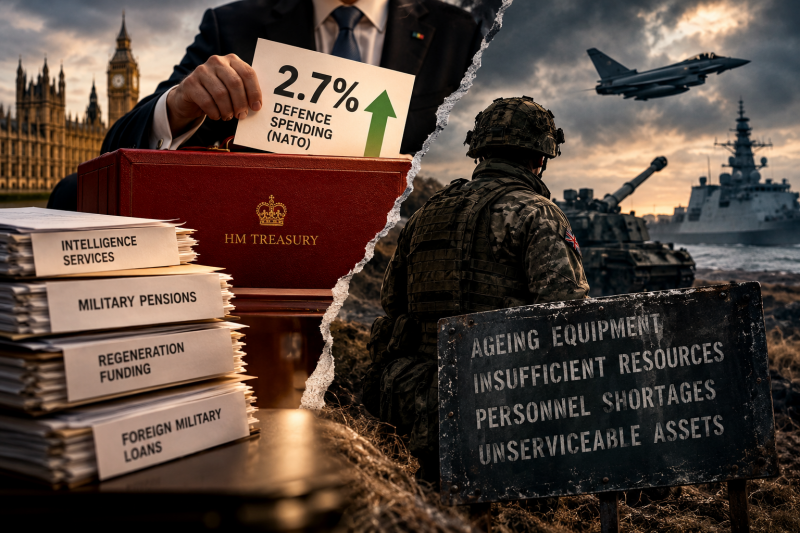
We are regularly told that Britain is committed to increasing defence expenditure, with ambitious targets stretching into the next decade. It sounds reassuring, until you consider how much of that funding remains dependent on future decisions. But even the headline figures deserve closer examination, as former Defence Secretary Sir Ben Wallace has pointed out. His concerns about defence accounting highlight an important distinction between expenditure that qualifies under NATO rules and the money actually available to the Ministry of Defence to strengthen our armed forces.
Some of the spending included in NATO's calculations might surprise people:
-
Intelligence Budgets: Certain intelligence expenditure can legitimately be counted towards NATO defence spending. Intelligence is essential to national security, but including it does not necessarily provide additional soldiers, ships or ammunition.
-
Military Pensions: Payments to retired military personnel are also included under NATO rules. These commitments must be honoured, but they do not improve today's operational readiness.
-
Regeneration Funding: The £200 million Barrow Transformation Fund supports the community and infrastructure surrounding Britain's nuclear submarine industry. Supporting the workforce is important, but improving local infrastructure is not the same as putting another operational warship to sea.
There are perfectly valid reasons for including these costs, but they do not necessarily translate into greater military capability, which is why headline spending percentages don't tell us the whole story about the state of our armed forces.
The real question is not simply how much Britain promises to spend, but whether the government is prepared to commit the resources needed to deliver a credible military capability.
A Game of Military 'Top Trumps'
For years, Britain's defence debate has focused heavily on the number of warships, aircraft and armoured vehicles we possess, rather than how many are actually ready to deploy. For example, an aircraft waiting for spare parts is not much use. Neither is a warship without sufficient crew or an artillery system without ammunition.
The government has announced substantial investment in new fighter aircraft, warships, armoured vehicles and weapons. These are welcome commitments, but much of the equipment will take years to enter service, while our existing armed forces still need the resources to operate effectively today.
This is where day-to-day funding, known as Resource Departmental Expenditure Limit (RDEL), becomes so important. Buying sophisticated equipment is one thing; maintaining it, crewing it and keeping it operational is quite another.
Meanwhile, countries such as Poland and several Nordic states are investing heavily in military capability, while Britain continues to face delayed procurement programmes, personnel shortages and concerns about its ability to sustain a prolonged conflict.
Surely the measure of military strength should be what we can actually deploy, rather than what we technically own?
Modern Warfare Is Moving Faster Than Westminster
The situation becomes even more concerning when you consider how quickly warfare is changing.
Ukraine has demonstrated that military technology can evolve in weeks rather than years. Drones, electronic warfare, artificial intelligence and increasingly sophisticated battlefield systems are transforming how conflicts are fought.
During Exercise Hedgehog 2025 in Estonia, Ukrainian drone operators demonstrated how their battlefield experience could expose weaknesses in NATO forces during simulated combat.
The lesson is fairly straightforward. Modern armed forces need to adapt quickly, test new technology and get effective equipment into service before it becomes obsolete. Unfortunately, Britain's traditional procurement system is not exactly renowned for its speed or flexibility. However, that does not mean abandoning conventional military capability. Drones might help clear a battlefield, but soldiers are still needed to hold territory. Ships, aircraft, artillery and properly trained personnel remain essential.
What Britain needs is a sensible balance between rapidly developing technology and the conventional forces required to fight and sustain a conflict.
The concern is whether our political leaders are prepared to provide the funding and flexibility needed to achieve either.
Thirty Years of Questionable Priorities
None of this happened overnight.
Successive governments have spent decades reducing defence's share of national income while facing ever-growing demands from the NHS, welfare and other domestic spending commitments. Those services are important, but protecting the country is surely one of the most fundamental responsibilities of government.
The difficulty is that Britain has continued to maintain the ambitions of a major military power without consistently providing the resources necessary to support them.
We want to lead NATO operations, maintain a nuclear deterrent, support our allies and respond to international crises. Yet we repeatedly find ourselves debating whether our armed forces have sufficient personnel, equipment and ammunition to fulfil those commitments.
There is a rather obvious contradiction here.
We cannot keep promising a world-class military while treating the cost of maintaining one as an inconvenient expense.
John Healey and the Decisions Still to Be Made
John Healey's move from Defence Secretary to Chancellor raises some rather uncomfortable questions. After all, he resigned from the defence role in June, arguing that the Treasury was unwilling to provide the funding needed to protect Britain at a time of growing international threats. It was a principled stand, or so it appeared.
Yet just weeks later, he found himself occupying the very office he had criticised. Now that he has the opportunity to influence those funding decisions, we are being offered an Innovative Defence Finance Taskforce and another Spending Review before the government explains how it intends to meet its longer-term commitments.
To be fair, the latest Budget has allocated additional resources to the Defence Investment Plan. But the larger question of how Britain will meet its future defence spending targets remains unresolved.
It does make you wonder whether Healey's resignation was entirely about securing the resources our armed forces needed, or whether political advancement ultimately became the greater priority. After all, if the threats facing Britain were serious enough for him to resign as Defence Secretary, surely they should be serious enough for him to act with the same urgency now that he is Chancellor?
Final Thoughts
For decades, successive governments have allowed Britain's military capability to deteriorate while maintaining the ambitions of global military leadership. Now, with threats escalating and modern warfare evolving at unprecedented speed, the government continues to promise future investment while the difficult decisions remain unresolved.
There is a fundamental contradiction in warning the British public about the threat posed by Russia while failing to adequately address the weaknesses in our own military readiness. Young people are being asked to defend a country whose government seems reluctant to make defence the priority its own warnings suggest it should be.
The absurdity of government policy is that Westminster warns of an increasingly dangerous world, yet when it comes to providing the funding needed to strengthen our armed forces, the answer is another review, another taskforce and another promise to make the difficult decisions tomorrow.
Add comment
Comments