

You can't preach tolerance while being intolerant. You can't demand equality while expecting special treatment. You can't champion human rights while dismissing the rights of those who disagree with you. And you certainly can't lecture the British public about doing the right thing while behaving as though the rules don't apply to you.
Yet increasingly, that appears to be the defining characteristic of modern left-wing politics and, in particular, the Labour Government. We are constantly told what to think, what to say, how to behave, what we should accept and what sacrifices we must make for the greater good. But when those delivering the lectures find themselves on the wrong side of their own principles, suddenly there is an explanation, an exception or a convenient excuse. Apparently, principles are only principles when somebody else has to follow them.
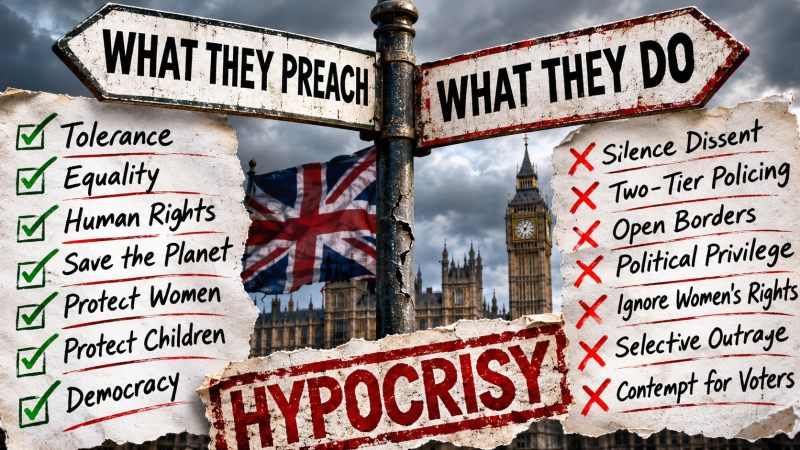
The Great British Hypocrisy Test
You can't preach tolerance while refusing to tolerate anyone who disagrees with you.
We've all seen the placards proclaiming "Refugees Welcome" and heard activists demanding compassion, tolerance and understanding. But how often are those same people prepared to listen to someone who raises legitimate concerns about immigration, housing pressures, public services or border security? Too often, the response is not discussion but accusation. People asking reasonable questions are labelled racist, far-right or xenophobic before they've even finished speaking. And when political demonstrations descend into intimidation, threats or violence, the contradiction becomes even more glaring. Of course, many campaigners protest peacefully and respect opposing views. But those who demand tolerance while attempting to silence others undermine their own message.
You can't demand that your views be respected while refusing to respect anyone else's right to express theirs.
Tolerance is not about agreeing with everybody. It is about accepting that other people have the right to disagree.
You can't champion human rights for illegal migrants while overlooking the rights of British citizens.
Human rights have become central to Britain's immigration debate.
We hear repeatedly about the rights of asylum seekers, the circumstances in which people can be removed and the legal obligations preventing deportation. But what about the rights of British citizens?
What about the right to feel safe in their communities? The rights of women and children? The interests of residents whose local services are already overstretched? Or the right of taxpayers to expect an immigration system that is properly managed and enforced?
The Human Rights Act protects everyone within the UK's jurisdiction, regardless of nationality or immigration status. That is an important legal principle. But it does not mean that every immigration claim must succeed, that borders cannot be controlled or that the interests of the wider public should be ignored. Nor should legitimate concerns about immigration automatically be dismissed as hostility towards foreigners.
You can't insist that human rights are universal while behaving as though the rights and concerns of British citizens are somehow less important.
Compassion and border control are not mutually exclusive. A responsible government should be capable of delivering both.
You can't defend the right to protest for one cause while appearing to restrict it for another.
Britain has witnessed enormous pro-Palestinian demonstrations, alongside protests about immigration, national identity and other politically contentious issues.
The right to peaceful protest belongs to everyone.
Yet there is a growing perception that demonstrations associated with progressive causes are treated more sympathetically than those organised around patriotism, immigration concerns or national identity. Questions have also been raised about face coverings and the consistency of policing. The law now provides powers to restrict identity concealment at designated demonstrations, and police have applied face-covering restrictions to pro-Palestinian protests too. So the issue is not that one movement has a legal exemption while another does not. The question is whether the same standards are being applied consistently, visibly and without political favour.
If covering your face to conceal your identity is unacceptable at one demonstration, it should be equally unacceptable at another under comparable circumstances. And if peaceful protest is a fundamental democratic right, that right cannot depend on whether the authorities approve of the message.
You can't defend freedom of assembly for causes you support while appearing to resent it when the British public marches for something you oppose.
You can't claim to defend women's rights while dismissing women's concerns about single-sex spaces.
For decades, women fought for equality, dignity, privacy and protection from discrimination. Yet some women now find themselves having to defend the very principle of female-only spaces.
In April 2025, the UK Supreme Court ruled that the terms "woman", "man" and "sex" in the Equality Act 2010 refer to biological sex.
That ruling provided important legal clarity.
For the purposes of that Act, a transgender woman is not legally classified as a woman on the basis of acquired gender, although transgender people continue to enjoy protection against discrimination. The implications are particularly important for women's changing rooms, hospital accommodation, refuges and other intimate or vulnerable settings. Yet implementation has been complicated, including within the NHS, where guidance on hospital accommodation has been undergoing revision.
Why should women have to keep arguing for privacy and dignity in spaces specifically intended for them? Respecting transgender people and protecting women's sex-based rights should not be treated as incompatible objectives. But neither should women be expected to surrender their concerns about safety, dignity or privacy simply because those concerns are politically uncomfortable.
You can't claim to champion women's rights while dismissing women who ask for those rights to be respected.
And you cannot call something a single-sex space while ignoring what single-sex means in law.
You can't demand justice for children overseas while overlooking children abused in Britain.
Thousands have marched through British streets protesting against the suffering and deaths of Palestinian children. There is nothing wrong with demanding protection for innocent children caught in war. Their suffering deserves compassion.
But where is the same sustained political outrage over the vulnerable girls who were groomed, sexually exploited and raped in towns across Britain? Rotherham, Rochdale, Telford and other communities have witnessed appalling abuse, compounded by serious institutional failures. Baroness Casey's national audit exposed failures to recognise patterns of exploitation, confront uncomfortable evidence and protect vulnerable children. In some areas, concerns about racism and community tensions contributed to the failure to address what was happening.
Survivors and campaigners have fought for years to secure justice, often against extraordinary resistance. But where is the comparable determination from every politician and activist who claims that protecting vulnerable children is an overriding moral duty?
Caring about Palestinian children does not prevent anyone from caring about British victims. Many people care deeply about both. But where are the marches and the ‘left’ when there are failures in protecting British white girls?
You can't claim that every child's life matters while treating the suffering of children in your own country as a secondary political concern.
Compassion should never depend on whether a victim fits a preferred political narrative.
You can't fight for equality while demanding preferential treatment based on race or identity.
Equality should be one of the simplest principles to understand.
People should be treated fairly, judged on their abilities and protected from discrimination.
Yet parts of modern identity politics seem increasingly preoccupied with categorising people according to race, gender, background and other personal characteristics. Instead of asking whether everyone has a fair opportunity, the debate sometimes becomes about which groups should receive preferential treatment.
There are legitimate reasons to address disadvantage and discrimination, and British equality law permits certain proportionate positive-action measures. But there is an important distinction between removing unfair barriers and creating new ones.
Why should someone's race, sex or identity automatically determine how deserving they are of an opportunity?
Why should one person's achievements be discounted or another person's prospects improved simply because of the demographic category to which they belong?
You can't demand a society free from discrimination while supporting unfair discrimination whenever it produces your preferred outcome.
True equality should mean fairness for everyone, not a constantly changing hierarchy of who deserves special consideration.
You can't lecture the public about climate change while expecting an aircraft to make a special journey to collect you.
Prime Minister Andy Burnham's recent Caribbean trip provided a rather spectacular example of the political double standard.
A government aircraft departed Stansted, stopped in Manchester to collect Burnham and his wife, and then continued towards the Caribbean. Critics estimated that the detour cost taxpayers around £20,000, although the figure has not been officially confirmed. Downing Street cited security and operational considerations. But this is the same Labour Party that criticised Rishi Sunak for using aircraft and helicopters for domestic journeys.
Ordinary people are encouraged to reduce their carbon footprints, use public transport and make environmentally responsible choices. Meanwhile, the Prime Minister's aircraft apparently needed to make a special stop in Manchester.
You can't demand environmental responsibility from millions of ordinary people while expecting them to accept exceptional arrangements for those in power without question.
Climate responsibility for the public. Special arrangements for the politicians.
You can't condemn politicians for taking taxpayers' money and then keep £16,876 yourself without expecting questions.
Angela Rayner built much of her political reputation on defending working people and challenging Conservative privilege. She previously criticised Conservative ministers receiving severance payments after short periods in office. Yet after resigning from government in September 2025, Rayner received a ministerial severance payment of £16,876. When she returned to the Cabinet in 2026, she faced demands to return it.
Her defence was that she had been out of office considerably longer than some of the Conservative ministers she had criticised. That distinction may be relevant, but it does not make questions about consistency unreasonable.
Then there was the stamp duty controversy, which led to her resignation after she underpaid approximately £40,000 in tax on a property purchase while serving as Housing Secretary — the very minister responsible for overseeing housing policy.
You can't build your reputation on condemning the conduct of political opponents and then act surprised when the public applies similar scrutiny to you.
If something is unacceptable when the Conservatives do it, Labour should be prepared to explain why the same principle does or does not apply to its own ministers.
You can't claim to defend democracy while treating voters with contempt.
Democracy is apparently wonderful, provided people vote the way the political establishment wants them to.
We are constantly reminded about democratic values, political participation and the importance of respecting elections. Yet when voters support parties or policies that challenge the prevailing political consensus, some politicians and commentators seem remarkably quick to question their intelligence, motives or morality.
People concerned about immigration are dismissed as prejudiced. Those questioning public spending are accused of lacking compassion. Those challenging fashionable political ideas are treated as though disagreement itself is unacceptable. But democracy is not a system in which voters must reach an approved conclusion.
It is a system in which people have the freedom to make their own choices.
You can't claim to respect democracy while showing contempt for the people exercising it.
Final Thought
Hypocrisy is hardly new to politics, and no political party has a monopoly on it.
But what makes the modern political left particularly frustrating is the apparent moral superiority with which so many of its arguments are delivered. We are told to be tolerant, compassionate, inclusive, environmentally responsible and respectful of human rights. All perfectly reasonable principles. But those principles mean very little if they are applied selectively.
- You can't demand tolerance while silencing disagreement.
- You can't champion human rights while dismissing the rights and concerns of British citizens.
- You can't defend women's equality while refusing to listen to women defending their own spaces.
- You can't demand justice for children overseas while failing to confront the abuse of children at home.
- You can't preach equality while expecting preferential treatment, or demand sacrifice from the public while enjoying privileges yourself.
- And above all, you cannot claim the moral high ground simply because you belong to a particular political movement.
The British public does not expect politicians or campaigners to be perfect. But it has every right to expect consistency, accountability and a willingness to practise what they preach.
Because if your principles only apply to people you disagree with, they aren't principles at all.
They're political hypocrisy dressed up as moral superiority.
Add comment
Comments