

Britain is being asked to confront its past once again. But at what point does acknowledging history become an exercise in political guilt, financial demands and national self-flagellation?
Prime Minister Andy Burnham has opened the door to a formal apology for Britain's involvement in the transatlantic slave trade, while insisting that financial reparations remain off the table. Yet following the Commonwealth summit, Britain has agreed to structured discussions about the historical harms of slavery.
And therein lies the problem.
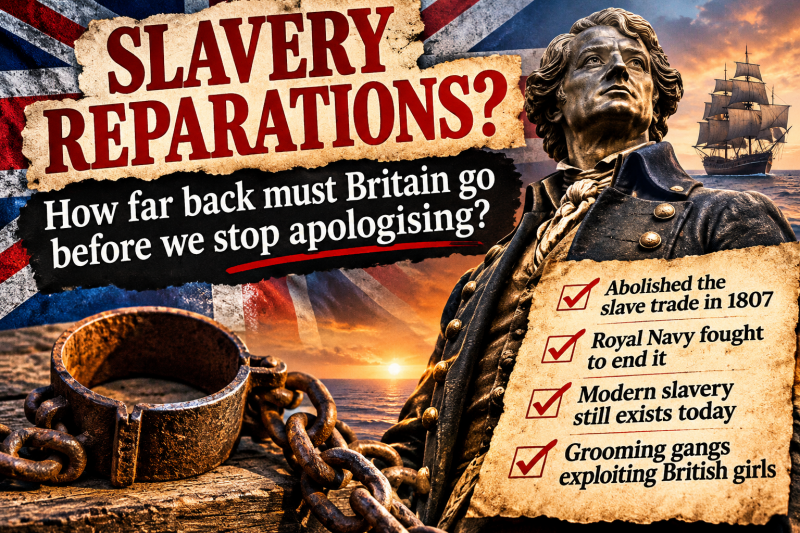
When a government opens negotiations about historical injustice, how long before an apology becomes a demand for compensation?
Nobody disputes that slavery was barbaric. Nobody should attempt to defend it. But the idea that today's British population should somehow carry the guilt, let alone the financial responsibility, for events that took place centuries ago is extraordinary. And perhaps even more extraordinary is how selectively our history is being remembered.
Britain Didn't Just Participate in Slavery. It Helped End It.
There is an inconvenient part of British history that rarely receives the same attention as Britain's involvement in the slave trade.
Britain became one of the world's leading forces in suppressing the transatlantic slave trade.
In 1807, Parliament abolished the British slave trade. The following year, the Royal Navy established its West Africa Squadron to intercept slave ships and disrupt the trade. For decades, British sailors patrolled dangerous waters, confronted slave traders and helped liberate tens of thousands of enslaved Africans. Many sailors died through disease, harsh conditions and the dangers of their mission. Britain subsequently abolished slavery across most of its empire in 1833, with emancipation taking effect in 1834, although many formerly enslaved people were forced into an apprenticeship system before full freedom followed.
Was Britain innocent? Absolutely not.
But was Britain instrumental in bringing an end to an appalling international trade? Absolutely.
So why does the conversation so often concentrate on Britain's historical guilt while giving comparatively little recognition to those British citizens who fought to end slavery?
And here's a thought.
If we are going to discuss compensation for historical suffering, should we also consider the descendants of the British sailors who lost their lives fighting the slave trade? Of course, that would be equally absurd. But it illustrates just how ridiculous the principle of inherited financial responsibility can become.
Slavery Wasn't Invented by White Europeans
Another uncomfortable historical fact is that slavery existed across continents, civilisations and cultures long before Britain's involvement in the Atlantic trade.
Africans enslaved other Africans. European Christians were captured and enslaved by North African corsairs. The Ottoman Empire practised slavery. So did societies across Asia, the Middle East and the ancient world. In some African kingdoms, rulers and merchants actively participated in supplying captives to European slave traders. That doesn't diminish the responsibility of those Europeans who bought, transported and exploited enslaved Africans. But it does demonstrate that slavery was never exclusively a British invention, nor was it a crime committed by one race against another throughout history. People of different backgrounds were both perpetrators and victims.
If historical responsibility is to be inherited, where exactly does the chain of liability begin and end?
Do we investigate every civilisation, every empire and every ruling dynasty? Or do we simply concentrate on modern Britain because it is a convenient country from which to demand an apology and potentially financial concessions?
Shall We Send the Romans a Bill While We're At It?
Let's follow this argument to its logical conclusion.
The Romans invaded Britain, conquered its people, imposed their authority and enslaved inhabitants. Should we send Italy an invoice?
The Vikings raided British settlements, killed inhabitants and carried people into slavery. Perhaps Denmark and Norway should expect a letter.
What about the Norman Conquest? Should the descendants of William the Conqueror be asked to compensate families whose ancestors lost their land in 1066?
And if modern generations are financially responsible for their ancestors' actions, where does that leave Germany and the atrocities of the Second World War? Germany has, of course, already made substantial reparations to victims of Nazi persecution and their families. But those arrangements arose from specific historical crimes and post-war agreements, not an unlimited principle that every generation must pay indefinitely for everything its ancestors did.
History is full of conquest, exploitation, violence and injustice. If we attempt to settle every historical grievance through the bank accounts of people alive today, where on earth does it end?
At some point, we have to recognise that history cannot be undone by sending the bill to people who weren't even born.
A King Who Should Be Defending Britain's Full History
King Charles has also spoken of the horrors of the transatlantic slave trade, expressing profound sorrow about that period of history. There is nothing wrong with acknowledging suffering. A monarch should be capable of recognising historical wrongdoing. But where is the equally powerful recognition of Britain's abolitionists, its campaigners and the Royal Navy personnel who helped bring the trade to an end? The monarchy itself has historical connections to the slave trade, and those deserve examination. But the history of the British Crown and the British people is considerably more complicated than a single narrative of national guilt.
A strong monarch should acknowledge Britain's mistakes without appearing embarrassed by its achievements.
Charles is not responsible for the actions of his ancestors any more than an ordinary British taxpayer is responsible for theirs. Yet the danger is that endless expressions of national regret create the impression that modern Britain must continually apologise for existing. We should be capable of telling the whole story, not just the chapters that make us feel ashamed.
Britain Cannot Afford Another Open-Ended Financial Commitment
And then there is the rather inconvenient matter of money. Britain is struggling with enormous pressures on public spending. Our NHS faces serious challenges. Councils are under financial strain. Infrastructure needs investment. Defence requires funding. Households are dealing with high living costs, while taxpayers are repeatedly told that difficult decisions are unavoidable.
Yet somehow, we are finding time to negotiate over historical wrongs committed centuries ago. Burnham insists that financial reparations are not on the table. Good.
Then they must remain firmly off the table, regardless of how much diplomatic pressure is applied.
There is also a legitimate question about whether development assistance, debt restructuring or other financial arrangements could eventually be presented as an alternative form of reparatory justice. International cooperation can be worthwhile. But any expenditure should be justified by its present-day benefits, properly scrutinised and transparently accounted for. It should not become compensation by another name.
Britain's government has a responsibility to the people it represents today, not an unlimited financial obligation to every nation with a historical grievance.
Meanwhile, Modern Slavery Is Happening Right Now
Perhaps the greatest irony of this entire debate is that slavery has not disappeared. Modern slavery, forced labour, sexual exploitation and human trafficking continue across the world. Criminal trafficking networks exploit vulnerable people, including those moving along irregular migration routes towards Britain. Not everyone arriving in a small boat is a trafficking victim, and smuggling is not automatically the same as trafficking. But exploitation within these networks is a serious and immediate problem.
And what about one of the most appalling scandals in modern British history: the organised grooming and rape of vulnerable young girls, such as the grooming and rape gangs in Rotherham, Rochdale and Telford, where vulnerable British girls were/are systematically sexually exploited by men, including offenders of Pakistani heritage?
If Britain is expected to pay reparations for historical atrocities, perhaps we should ask Pakistan for reparations too? After all, these victims are alive today, and many are still suffering the consequences.
Of course, Pakistan cannot automatically be held responsible for crimes committed by offenders of Pakistani heritage, many of whom were British citizens. But that rather proves the point: why should an entire nation be held financially responsible for the crimes of others?
Surely preventing modern slavery and protecting children from sexual exploitation should command more urgency than debating whether the descendants of historical victims should receive compensation funded by today's British taxpayers, generations removed from those responsible for the slave trade.
Britain could demonstrate genuine international leadership by strengthening action against trafficking networks, supporting victims and working with other countries to dismantle modern slavery. That would achieve something tangible. It would save lives rather than simply generate another round of diplomatic speeches.
Political Correctness Is No Substitute for Leadership
What concerns me most about this debate is the apparent willingness of political leaders to engage in an endless cycle of historical guilt. There seems to be a growing political culture in which apologising for Britain's past is considered virtuous, while defending its achievements is treated with suspicion. But patriotism does not require historical ignorance.
We can acknowledge Britain's involvement in slavery while celebrating the people who fought to abolish it. We can recognise the suffering of enslaved Africans without pretending that slavery was exclusively a British crime. And we can maintain constructive relationships with Commonwealth nations without accepting that today's taxpayers owe an inherited financial debt.
A confident government should be capable of saying all three without hesitation.
Instead, we risk creating a situation in which every expression of regret encourages another demand, another negotiation and another expectation that Britain must somehow make amends. It is not unreasonable for countries to raise their history. Nor is it unreasonable for Britain to listen. But listening does not require surrendering sound principles. And a government that cannot distinguish between acknowledging historical wrongdoing and accepting present-day liability risks looking weak rather than compassionate.
Final Thought
Britain helped create a terrible chapter of history. It also helped bring that chapter to an end. We should remember both.
But if today's British taxpayers are expected to answer for the sins of people who died centuries ago, perhaps someone should explain why we aren't also entitled to compensation for the sacrifices of those who fought to abolish slavery.
And while our politicians debate the past, who exactly is taking responsibility for the slavery and exploitation still happening today?
Add comment
Comments