

When the Government cannot decide who counts as a working person, perhaps it's time to ask whether it understands the people it's governing.
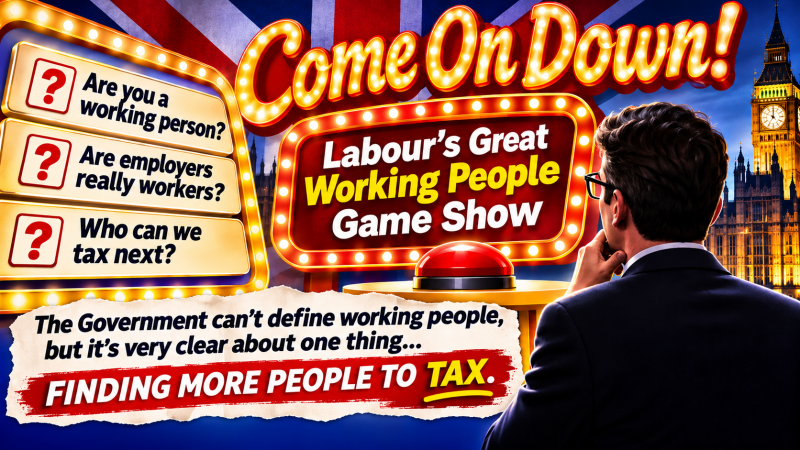
Come on down! You're the next contestant on Labour's latest game show: Are You a Working Person? The rules are simple. Well, actually, they're not. Nobody seems to know what they are, least of all the Government.
Are you employed? Congratulations, you're a working person! Do you run a small business, employ a couple of people and work 70 hours a week? Sorry, apparently you might not qualify. Have you managed to save a little money? Own a property you rent out? Perhaps you've moved into another category altogether.
And the star prize? A tax bill!
It would be funny if it weren't so ridiculous.
Correct the Record? Or Rewrite the Rules?
The latest confusion came when Treasury minister Emma Reynolds declared that she didn't consider employers to be working people. Apparently, being an employer somehow separates you from the people who actually work.
Following the backlash, Chancellor John Healey contradicted her position, and Reynolds subsequently stood up in the House of Commons to announce that she wanted to "correct the record".
Correct the record? What an extraordinary choice of words.
It wasn't the parliamentary record that got it wrong. It was Reynolds herself who made the original statement. Rather than simply acknowledging that she'd said something ridiculous, she appeared to distance herself from her own words, almost as though she were correcting somebody else's mistake.
It's the sort of political manoeuvre that leaves the public wondering whether they're being gaslighted. We heard what she said. She knows what she said. Yet somehow, we're now supposed to treat it as an unfortunate error in the record. And here's the uncomfortable question: was she correcting a genuine mistake, or correcting a politically embarrassing admission of what she actually believes?
So there we have it. One minister says you're not working, another says you are, and suddenly the rules have changed halfway through the game. But this is about more than one minister putting her foot in it. It's about a Government that appears determined to divide Britain into convenient little boxes: employers versus employees, landlords versus tenants, rich versus poor, taxpayers versus benefit recipients.
Except real life doesn't work like that.
The self-employed plumber might employ an apprentice. The pensioner might have spent 45 years paying taxes. The employee might have savings, shares or a rental property. The person receiving benefits might also be working, caring for a disabled relative or temporarily unable to work.
People aren't permanently assigned to one category. Their circumstances change. That's life. Yet Labour seems obsessed with deciding who belongs on which side of an imaginary dividing line. And then there are three extraordinary political statements that rather neatly expose the problem.
Three Statements That Say It All
First, the argument that national security shouldn't come at the expense of social security. It sounds compassionate, but national defence and welfare are both serious responsibilities of government. Pretending difficult spending choices can simply be avoided isn't a strategy. Protecting the country and supporting vulnerable people should not be presented as competing political loyalties.
Second, the suggestion that employers aren't working people. Try telling that to the café owner opening at six in the morning, the builder employing three tradesmen or the shopkeeper who hasn't taken a proper holiday in years. Apparently, the moment you start employing somebody else, you risk losing your place in Labour's working-person category.
Third, Pat McFadden's extraordinary revelation about the attitude of Labour colleagues: "Every meeting I have is 'who can we tax in order to pay benefits to others'. They're asking the wrong questions."
And there, in those three statements, lies the problem with Labour's entire approach to governing.
Rather than discussing how to grow the economy, encourage investment, create jobs or reduce dependency on welfare, the focus was on finding somebody else to tax. It's almost another round of Come On Down! Who's next in line to pick up the bill?
Of course, we need a welfare system. People become ill, lose jobs, grow old and experience hardship. A decent society supports those who genuinely need help. But surely the objective should be to build an economy where fewer people need that support, rather than continually searching for new sources of taxation to fund an ever-growing bill.
And that's where Labour's entire argument begins to unravel.
Britain doesn't need a government encouraging resentment between employers and employees, or treating people with savings as though they've somehow become privileged. We need businesses creating jobs, workers earning decent wages, sensible taxation, a sustainable welfare system and an economy that actually grows.
Instead, under Prime Minister Andy Burnham, we seem to have a government increasingly preoccupied with deciding which groups deserve protecting and which can be expected to pay more. It's an extraordinary distraction from the bigger problem: Britain's economic performance and the pressure on household finances. Because whether you're employed, self-employed, retired, running a business or receiving benefits, you still have to live in the same economy. And when that economy struggles, everybody feels the consequences.
The Government can keep dividing us into winners and losers, but the reality is that a failing economy doesn't discriminate.
Final Thought
Perhaps Labour has been asking the wrong question all along. It's not who counts as a working person? It's whether the Government is working for anyone. Forget rich versus poor, employers versus employees or taxpayers versus benefit recipients.
The real divide may simply be between the British public and a government that seems to have lost touch with the people it serves.
Come on down, Prime Minister Burnham. It's your turn to explain the rules.
Add comment
Comments