

Another day, another Labour U-turn. This time, it's Home Secretary Shabana Mahmood discovering that talking tough on immigration is considerably easier than delivering it.
Mahmood proposed making many foreign care workers wait up to 15 years before qualifying for permanent settlement in Britain. It was supposed to demonstrate that Labour was finally taking immigration seriously, with a tougher system where the right to remain permanently would have to be earned. Fast-forward to November 2026, and that 15-year wait has suddenly become five years for eligible care workers.
What changed? Has Britain solved its immigration problems? Have pressures on housing, public services and infrastructure miraculously disappeared?
Of course not.
What changed was the political temperature inside the Labour Party.
Once again, Labour performs another U-turn the moment its own MPs start complaining.
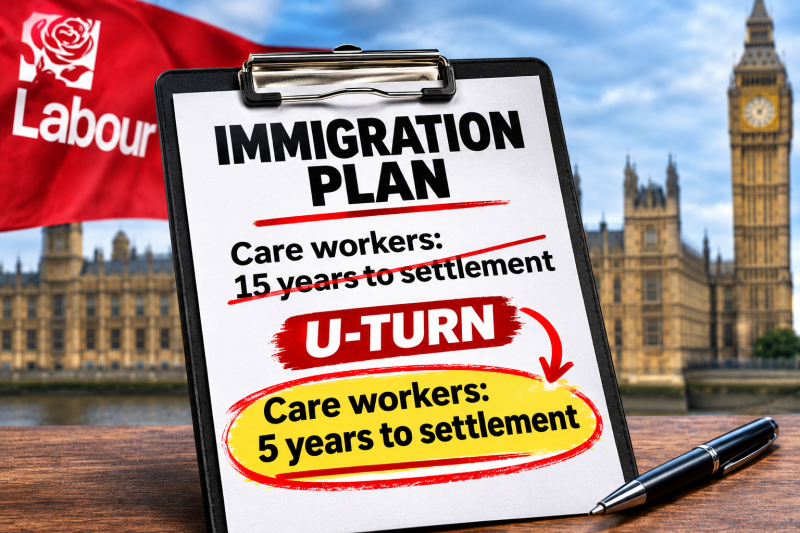
Tough Talk Meets Labour Reality
Following opposition from senior Labour figures, including Angela Rayner, and pressure from unions and backbench MPs, Mahmood has softened her proposals. Under the revised plans, care workers who arrived before May 2025, meet their visa conditions and earn at least £25,000 a year can qualify for permanent settlement after five years. However, those who do not meet the conditions may be offered another five-year visa, giving them a further opportunity to qualify. The change could benefit approximately 280,000 care workers and dependants.
Nobody should question the valuable contribution many foreign care workers make. They perform demanding jobs, often for modest pay, supporting some of the most vulnerable people in our society. Nor should we ignore legitimate concerns about changing settlement conditions for people who entered Britain under different expectations. But surely these were considerations the Government should have addressed before announcing such sweeping proposals?
Instead, Labour has delivered yet another masterclass in political incompetence: announce a tough policy, bask in the headlines, discover your own party doesn't like it, and quietly retreat.
It's difficult to escape the impression that Labour is more concerned about managing its internal divisions than managing immigration.
Immigration Policy by Committee
Immigration is one of the most contentious issues facing Britain, affecting housing, public services, infrastructure, workforce planning and long-term public spending. It demands clear objectives, credible evidence and consistent decisions. Yet Labour appears incapable of agreeing on what those decisions should be.
While some Labour MPs demand tougher immigration controls, others argue that restrictions risk unfairness and damage to essential services. Both concerns deserve consideration, but surely a competent government should resolve these differences before announcing major policy changes?
Instead, Mahmood announces a tough position, Labour colleagues object, and the Government retreats. It hardly inspires confidence in Labour's ability to put the country's interests ahead of its own internal divisions.
And where does Prime Minister Andy Burnham stand in all this?
Burnham has publicly backed Mahmood's revised proposals, describing them as a fair approach that recognises the contribution of overseas workers. However, it remains unclear whether he supported the original 15-year settlement requirement or only the decision to water it down. Yet, if the original proposals were too harsh, why did Labour take so long to recognise it? And if they were necessary to restore confidence in immigration controls, what has changed to justify the retreat?
Burnham may have inherited the policy from Starmer, but he now owns the U-turn. The question is whether his Government has a coherent immigration strategy or is simply making policy decisions to preserve political unity.
What About the Cost to Britain?
There is also the question of long-term public expenditure.
Conservative shadow home secretary Chris Philp has claimed the concession could cost taxpayers £10 billion, citing Home Office estimates relating to social care migration. That figure requires independent scrutiny. But the underlying question remains legitimate. What are the long-term financial consequences of granting permanent settlement to large numbers of migrants and their dependants?
Settlement can eventually provide access to benefits, subject to eligibility rules. It also creates a more permanent population with ongoing requirements for housing, healthcare, education and other services. Of course, migrant workers also pay taxes, contribute economically and provide essential services. That is precisely why the Government should publish a transparent assessment of both the costs and benefits.
Labour cannot keep asking taxpayers to trust its judgement while repeatedly changing policies (its mind) without clearly explaining the financial consequences.
At a time when public services are stretched and households are struggling with the cost of living, the public has every right to expect transparency. Instead, we get political announcements, internal arguments and another revised policy.
Why Are We So Dependent on Overseas Care Workers?
Perhaps the most uncomfortable question is the one Labour seems determined to avoid. Why has Britain become so dependent on recruiting care workers from abroad? If the care sector cannot attract enough British workers, shouldn't the Government be examining wages, working conditions, training opportunities and career progression?
Importing labour may provide short-term relief, but it does not necessarily address the structural problems within the sector. And this is where Labour's approach becomes particularly frustrating.
Rather than tackling the underlying problems, the Government appears content to preserve a system that relies heavily on overseas recruitment while simultaneously claiming it wants to reduce immigration.
You cannot credibly promise to reduce immigration while failing to address the reasons employers continue to recruit from abroad. Where is the serious long-term plan to make care work an attractive and sustainable career for British workers? Where is the investment in training, retention and workforce development? And where is the accountability for allowing these problems to persist?
Labour promised change. Yet when faced with a difficult decision, it seems to have opted for the familiar Westminster solution: postpone the problem and hope somebody else deals with it.
Is This Really a Tougher Immigration System?
To be fair, Mahmood has not abandoned her entire reform package. The Government still intends to increase the standard qualifying period for settlement from five to ten years for many migrants. Some refugees and people arriving through irregular routes could face considerably longer waits. But that makes this retreat all the more revealing. The Home Secretary insists settlement must be earned through contribution, yet her Government is already making significant exceptions before the wider reforms have taken effect. How many more exemptions will emerge when other industries, unions or Labour MPs begin applying pressure?
If every politically inconvenient proposal is watered down, what exactly will be left of Labour's supposedly tough immigration reforms?
This is the problem with a Government that appears to mistake announcements for achievements. A headline is not a policy. A speech is not a solution. And promising tougher immigration controls means very little if those promises cannot survive opposition from within your own party. Britain needs immigration rules that are fair, enforceable and sustainable. That means balancing the country's economic needs with pressures on public services and the legitimate expectations of people who entered legally. It requires political leadership, not another exercise in Labour Party damage limitation.
Final Thought
Labour promised the country change, but increasingly seems unable to decide what that change should look like. Shabana Mahmood talks tough on immigration, her colleagues object, and another promise is watered down. Meanwhile, Andy Burnham appears unable to impose a consistent direction on his own Government.
If Labour cannot even agree with itself on immigration, why should the British public have any confidence that it can control it?
Add comment
Comments