

We can find billions to develop economies overseas, but when it comes to fixing Britain, suddenly the cupboard is bare.
Britain is a wonderfully generous country. So generous, in fact, that we appear determined to solve everyone else's problems while struggling to pay for our own. Need better public services? There's a funding problem. Need stronger Armed Forces? Difficult decisions. Want to invest in British industry? Apparently, money doesn't grow on trees. But mention overseas development, and suddenly the Treasury remembers where it left its chequebook.
Now, before anyone reaches for the outrage button, I'm not suggesting we abandon starving children, disaster victims or people fleeing war. Genuine humanitarian assistance saves lives, and Britain has every reason to be proud of helping those who desperately need it. But somewhere along the way, foreign aid has evolved into something rather different.
We're no longer simply helping people survive. We're investing in foreign economies, supporting businesses overseas and taking considerable financial risks in some of the world's most unstable countries. And apparently, we're supposed to applaud without asking too many questions.
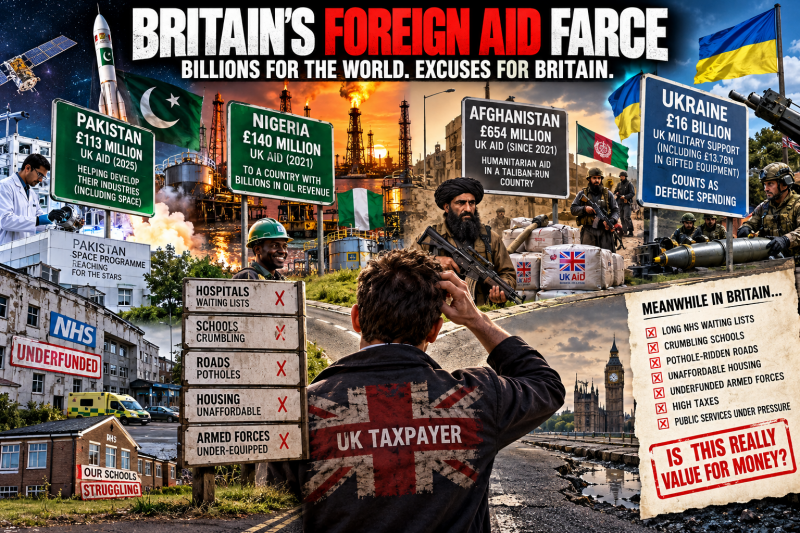
Pakistan: Reaching for the Stars While Britain Counts the Pennies
Let's start with Pakistan.
Pakistan has its own space programme, complete with satellites and ambitions to expand its technological capabilities. Good luck to them. Every nation has the right to develop its industries and pursue scientific progress. Meanwhile, Britain provided Pakistan with £113 million in bilateral aid in 2025. Now, to be clear, that money was not shown to be funding Pakistan's space programme. It was directed through development partners for other purposes. But it raises a rather interesting question. At what point does a country pursuing ambitious national development projects become sufficiently capable of financing more of its own needs? Because while other nations are building their futures, British taxpayers are being told to accept increasingly difficult choices about theirs. Perhaps our politicians should try applying some of that international development enthusiasm to developing Britain.
Nigeria: Oil Wealth and Overseas Assistance
Then there's Nigeria.
A country with enormous natural resources, substantial oil revenues and considerable economic potential. Britain provided £140 million in bilateral aid to Nigeria in 2021. That doesn't mean the money went into the Nigerian government's oil accounts. It didn't. But Nigeria illustrates a broader question about foreign assistance. Why do countries with substantial natural wealth continue to require external support for essential development? Of course, oil revenue doesn't automatically translate into prosperity. Corruption, inequality, poor infrastructure and weak institutions can prevent national wealth from reaching ordinary people. But surely that is precisely why we should be asking tougher questions. Are we addressing the underlying problems, or simply providing another source of money while those problems continue? After all, if the answer to decades of inadequate governance is another cheque, perhaps we should consider changing the question.
Afghanistan: Helping the Vulnerable Under Taliban Rule
And then we arrive at Afghanistan.
Britain has committed hundreds of millions of pounds in humanitarian assistance since the Taliban returned to power in 2021. The intention is understandable. Millions of ordinary Afghans need food, healthcare and basic support. But there is an uncomfortable reality. The Taliban controls the country. The British Government insists that aid is not provided directly to the Taliban, instead being distributed through international organisations and humanitarian partners. However, independent scrutiny has nevertheless acknowledged that the risk of the UK unintentionally funding the Taliban cannot be discounted, so there is every reason for us to demand answers to fundamental questions as to where the money is going. Because humanitarian assistance should help the victims of oppressive regimes, not inadvertently strengthen the regimes themselves.
Foreign Aid or Foreign Investment? There Is a Difference
Here's where things become particularly interesting.
Britain doesn't simply distribute humanitarian assistance. It also uses development funding to invest in businesses and industries overseas. Through British International Investment, UK-backed capital supports commercial enterprises in developing economies. The argument is that investment creates jobs, encourages economic growth and eventually reduces poverty.
Fair enough.
But parliamentary scrutiny has raised concerns about whether some investments are sufficiently focused on poverty reduction and whether they reach the poorest communities. So perhaps we should ask a question closer to home. If public investment can help create jobs, stimulate enterprise and build economic opportunity abroad, why does similar ambition so often appear unaffordable in Britain? Therefore, British taxpayers might reasonably wonder why they are helping to develop commercial opportunities overseas while being told that rebuilding their own communities requires yet more patience.
Charity is one thing, but an international investment strategy funded through the aid budget is quite another.
Defence Spending: Are We Strengthening Britain or Funding Someone Else's Arsenal?
Now for perhaps the most revealing part ....
The Government has promised increased defence spending, partly financed by reductions in foreign aid. Excellent. Britain's Armed Forces desperately need sustained investment. But there's an important detail buried in the accounting. Britain has committed around £16 billion in military financing to Ukraine since Russia's full-scale invasion. Approximately £13.7 billion of that represents gifted military assistance, funded largely through the Treasury Reserve rather than the Ministry of Defence's normal departmental budget. Yet that expenditure still appears in MOD spending figures. So when we hear politicians talking about billions spent on defence, we need to ask what those billions actually represent. New equipment for British forces? Replenished ammunition stocks? Additional personnel? Or weapons and equipment supplied overseas?
Supporting Ukraine's right to defend itself against Russian aggression is a legitimate national security decision. But supporting Ukraine and strengthening Britain's own military capabilities are not interchangeable achievements. A missile supplied to Ukraine may serve British security interests, but it is not a missile sitting in a British stockpile. And if we are serious about national defence, we need to know whether our military is becoming stronger, rather than simply whether the defence expenditure column is becoming larger.
Because you cannot defend the country with an impressive spreadsheet.
Terrorism: The Risk Nobody Should Ignore
Then there is the issue of aid reaching dangerous organisations.
In fragile states and conflict zones, humanitarian organisations operate under extraordinarily difficult circumstances. Local authorities may demand taxes, impose restrictions, interfere with deliveries or attempt to divert resources. In some places, those authorities are armed groups or internationally sanctioned organisations. That creates a genuine dilemma. Stop providing assistance, and innocent civilians may suffer. Continue providing it, and there is a risk that some resources or economic benefits will be captured by the very people responsible for the suffering. There is no credible evidence that Britain deliberately transferred billions of its foreign aid budget to terrorist organisations. But that does not mean the risks of diversion and misuse should be dismissed. Quite the opposite. Every pound intended for vulnerable people should be subject to meaningful scrutiny, particularly where extremist groups or oppressive regimes exercise control.
After all, compassion should never become an excuse for abandoning accountability.
Britain First in the Budget, Not Last in the Queue
The Government is already reducing foreign aid spending, with the budget expected to fall to approximately £9.2 billion by 2027/28. That's still an extraordinary amount of taxpayers' money. And while there are undoubtedly programmes that save lives and deliver genuine benefits, we should stop pretending that every overseas development project deserves automatic protection.
We need a clear distinction between emergency humanitarian assistance, long-term economic development, commercial investment and expenditure that primarily serves Britain's strategic interests. Each should have its own objectives, its own transparent accounts and its own test of value for money. Where there is corruption, unacceptable diversion risk or little measurable benefit, funding should be reconsidered. Where countries can increasingly finance their own development, British support should become less necessary. And where money is being used to develop industries overseas, ministers should be prepared to explain why that represents a better use of public resources than investment at home.
Britain cannot solve every problem in the world.
Nor should it be expected to.
Final Thought
Britain can find billions to develop foreign economies, invest in overseas businesses and supply military equipment abroad. Yet when taxpayers ask for better services, stronger Armed Forces and investment in their own communities, they're told there isn't enough money. Perhaps the real question isn't whether Britain can afford foreign aid. It's why Westminster seems so much better at finding money for everyone else's priorities than Britain's own.
Add comment
Comments