

Imagine Del Boy and Rodney trying to survive in today's Britain.
For generations, Del Boy and Rodney have had Britain laughing with their sarcastic remarks, affectionate insults and endless teasing.
Imagine Only Fools and Horses without the banter. No Del Boy calling Rodney a plonker, no Trigger getting his name wrong and none of those wonderfully awkward exchanges that made the programme a British comedy classic.
Of course, the Trotters weren't working in a conventional office, and nobody is suggesting that television comedy determines employment law. But their humour reminds us of something important: banter has always been part of the British character.
And with the controversy surrounding Labour's so-called “banter ban”, are we now in danger of losing the ability to distinguish harmless humour from genuine harassment?
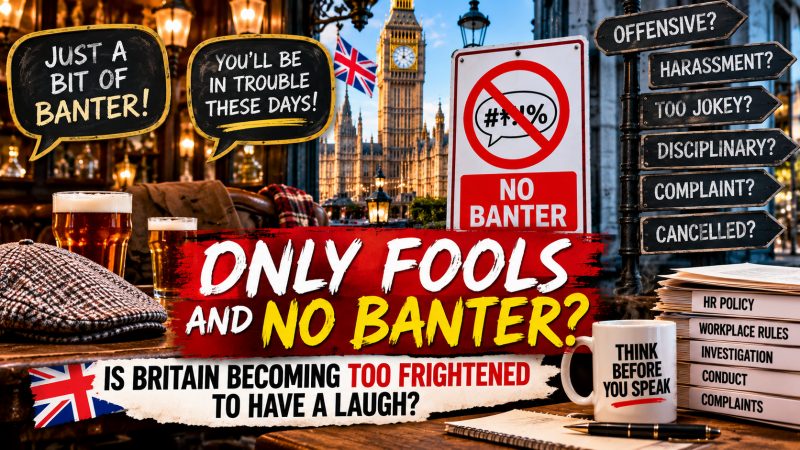
Banter: It's the British Way
Banter is woven into British culture. It's how we break the ice, build friendships, deal with difficult situations and sometimes show affection without actually admitting it.
From Del Boy's constant digs at Rodney to the exchanges between Basil Fawlty and his long-suffering guests, British comedy has always thrived on sarcasm, teasing and the occasional outrageous remark.
But what makes much of that humour work is context. We understand the relationships, the intentions and the difference between affection and cruelty.
Of course, there's a difference between sharing a laugh and deliberately humiliating someone. Racism, bullying and genuine harassment should never be excused as harmless banter.
And workplaces are not television sitcoms. Employees deserve protection from intimidation, discrimination and abuse, particularly when someone in authority takes advantage of their position.
But surely we can recognise that distinction without turning every awkward joke into a potential disciplinary hearing?
That is where the concern over Labour's workplace harassment reforms comes in.
The Government insists there is no ban on ordinary banter and that lawful free speech remains protected. But critics worry that placing greater responsibilities on employers to prevent harassment could encourage businesses to police conversations simply to avoid complaints.
And therein lies the problem.
The danger isn't necessarily that the law will outlaw every harmless joke. It's that employers, anxious to avoid legal trouble, may decide it's easier to discourage banter altogether.
You don't need to ban free speech to discourage it. Sometimes, making people frightened of the consequences is enough.
When Does Being Awkward Become Bullying?
Consider the recent case of Labour MP Tony Vaughan, who stood in the House of Commons on 29 October to apologise following findings that he had breached Parliament's bullying and harassment policy.
His misconduct included hugging a female member of his constituency staff without asking permission, taking her personal mobile phone from her hand to join an online meeting and failing to explain why two telephone calls had ended abruptly.
The independent panel concluded that his behaviour breached basic boundaries and courtesy, taking account of the imbalance of power between employer and employee. And let's be clear: nobody should be expected to tolerate bullying or unwanted physical contact. But the case also raises a broader question about the standards we are increasingly applying to everyday interactions.
At what point does poor judgement, an awkward encounter or simple discourtesy become something requiring a formal investigation and a public apology in Parliament?
The findings against Vaughan were not merely about hurt feelings. Nevertheless, the episode illustrates how seriously workplace behaviour is now scrutinised.
Are we creating a culture in which people become so anxious about making an innocent mistake that they avoid ordinary friendliness altogether?
A Nation Walking on Eggshells
Picture the workplace of tomorrow.
A colleague makes a joke. Someone laughs. Someone else doesn't. Before long, everyone is wondering whether they should have said anything at all. Perhaps the safest conversation will be no conversation at all. That might sound exaggerated, but the chilling effect of uncertainty is real enough to deserve consideration.
After all, freedom of speech means little if people become too frightened to exercise it.
The law already recognises that merely being offended does not automatically amount to harassment. Context, reasonableness and the seriousness of the behaviour matter. But will employers remember those distinctions, or will they simply decide that banning anything remotely controversial is the safest option? Britain should be capable of protecting people from genuine abuse without making humour, disagreement and ordinary conversation feel dangerous.
Final Thought
We all love Only Fools and Horses because its characters are gloriously imperfect. They tease, argue, offend, forgive and carry on. Their banter reminds us that humour is often built on familiarity, affection and the freedom to be ourselves.
Of course, a workplace requires different boundaries. But protecting employees from genuine harassment should not mean creating an atmosphere where everyone is afraid to speak.
If employers become fearful of harmless jokes and employees become frightened of saying the wrong thing, are we really creating a kinder society — or simply a quieter, more suspicious one?
Because Britain doesn't need to lose its sense of humour to learn how to treat people with respect.
Add comment
Comments