

As Britain prepares to honour those who fought and died for our freedom, an extraordinary incident at a Wetherspoon pub has raised a deeply troubling question: when did wearing a Remembrance poppy become a reason to refuse someone entry to a British pub?
At The Star in Gosport, Hampshire, veterans and other customers wearing Remembrance poppies were reportedly turned away, with staff suggesting the symbol could be considered political. Some were allegedly told they could enter if they removed their poppies.
For a country preparing to honour generations of servicemen and women, the incident is difficult to comprehend. But what makes it particularly troubling is not simply what happened. It is what the decision appears to say about our attitude towards remembrance.
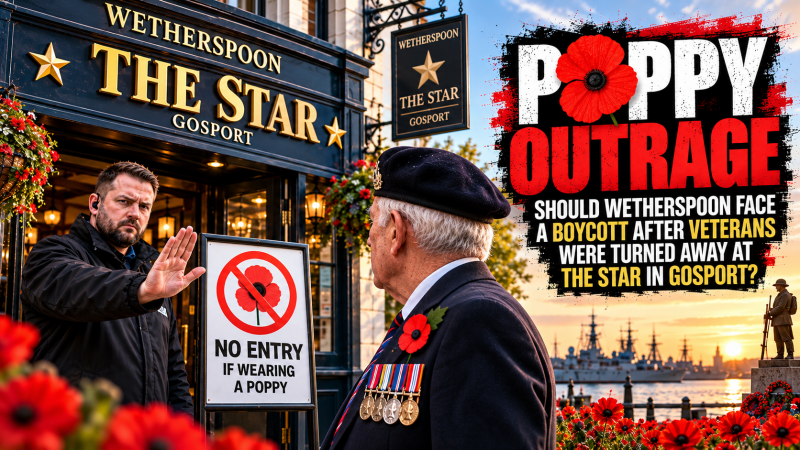
When Did Remembrance Become Political?
The red poppy is not a party-political badge. It represents remembrance, sacrifice and respect for those who served, those who died and the families left behind. Yet here were veterans, standing outside a British pub, reportedly being asked to remove the very symbol that honours their fallen comrades.
Think about that for a moment.
One of those affected, former Army gunner Scott Schillemore, spoke of losing a friend in Afghanistan and the importance of gathering to remember absent friends. Following the incident, he reportedly vowed never to return to Wetherspoon.
And can anyone seriously blame him?
After all, wearing a poppy is not about supporting a political party or endorsing government policy. It is about remembering the sacrifices made by generations of British servicemen and women.
If that has become controversial, surely we should be asking how we reached this point.
Wetherspoon's Explanation: Does It Really Add Up?
To be fair, Wetherspoon insists there is no nationwide ban on poppies. Chairman Tim Martin has highlighted the company's support for the Royal British Legion, including selling poppies in its pubs and raising more than £55,000 for the Poppy Appeal last year.
The company also explained that additional security measures were introduced because demonstrations were taking place nearby.
That context deserves consideration. However, it does not resolve the central question: why were customers reportedly asked to remove their Remembrance poppies?
More concerning still, Hampshire police reportedly disputed the company's suggestion that officers had advised the pub to close.
This raises further questions about who made the decision, what instructions staff were following and whether Wetherspoon's management fully understood what was happening. Although Wetherspoon has confirmed that wearing a Remembrance poppy is now permitted at The Star in Gosport and throughout its pub chain. The company maintains that there was never an official poppy ban.
But... hasn't the damage already been done?
Is It Time for Customers to Vote With Their Feet?
And that brings us to the wider issue of accountability.
Wetherspoon has every right to explain its actions. Equally, the British public has every right to decide where it spends its money.
Of course, a nationwide boycott would affect individual pubs and employees who had nothing to do with the Gosport incident. The company's longstanding support for the Poppy Appeal should also be recognised.
But does that mean customers should simply accept what happened and move on?
Surely not....
If a major British pub chain allows veterans and other customers to be turned away for wearing a Remembrance poppy, it must expect consequences for its reputation.
This is not about demanding special treatment for veterans. It is about expecting basic respect for the people who served our country and the symbols through which we remember their sacrifice.
Perhaps the clearest message customers can send is to take their business elsewhere until Wetherspoon demonstrates that such an incident will not happen again.
Because ultimately, respect for our Armed Forces should not depend on which pub we choose to enter.
Final Thought
Our servicemen and women fought, suffered and died defending the freedoms we enjoy today. Yet in Gosport, veterans and other customers were reportedly told to remove the symbol honouring that sacrifice simply to enter a British pub.
Wetherspoon says it supports remembrance. But surely that support must mean more than selling poppies, collecting donations and apologising when things go wrong.
If a major British business cannot ensure that veterans are treated with dignity while wearing a Remembrance poppy, why should the British public continue rewarding it with their custom?
And perhaps the most disturbing question of all: how have we reached a point where those who defended our freedoms are made to feel unwelcome for remembering those who never came home?
Add comment
Comments