

Britain has historically prided itself on equality, tolerance and freedom of speech. But are those principles now being applied consistently, or have we reached a point where what you say matters less than who you say it about?
Make fun of men and it may be dismissed as harmless banter. Make fun of women and you may be accused of misogyny. Mock Christianity and it may be regarded as comedy. Mock Islam and accusations of Islamophobia may follow. Criticise establishment or so-called uniparty politics and it may be regarded as legitimate political debate. Support progressive ideology or the political consensus, however, and you may find yourself labelled intolerant or far-right.
Of course, these are not universal rules, but the perception of double standards raises an uncomfortable question: Have we become selective about whose opinions deserve respect and whose freedom of expression we are prepared to defend?
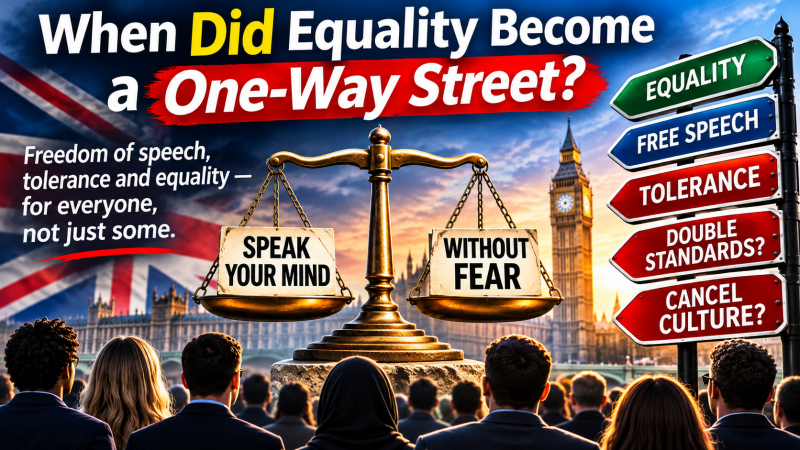
Equality Should Not Depend on Who You Are
The Equality Act 2010 protects people against discrimination on grounds including race, sex, religion or belief, and sexual orientation. It does not establish a hierarchy in which some identities deserve greater legal protection than others. Yet public attitudes can sometimes appear less consistent.
We rightly condemn racism, sexism, religious hatred and homophobia. But if these principles are genuinely about equality, surely they should apply to everyone? If a joke about someone's race is unacceptable, why should our response depend on which race is being mocked? If ridiculing religious beliefs is considered legitimate satire, should that freedom not extend to Christianity, Islam and every other religion?
Context matters, and genuine discrimination must be challenged. However, equality should be a principle applied consistently, not a privilege awarded according to identity or political allegiance.
When Disagreement Becomes Intolerance
Perhaps one of the most concerning developments in political debate is the growing tendency to confuse disagreement with hostility.
Question Britain's immigration policy, particularly the arrival of predominantly young adult men through unauthorised routes, and accusations of racism or xenophobia may follow. Yet there is an important distinction between welcoming skilled professionals who enter Britain through established legal routes and questioning whether the Government has adequate control over those arriving without prior authorisation. These are legitimate policy questions that deserve answers, rather than automatic accusations of being a racist.
Challenge aspects of gender identity policy and you may be labelled transphobic. Criticise progressive political ideas and you risk being described as far-right. Yet disagreeing with a policy does not automatically mean hating the people affected by it.
This is where tolerance becomes contradictory. How can someone claim to support diversity and inclusion while refusing to tolerate an opinion that differs from their own? Surely diversity of thought should matter just as much as other forms of diversity.
The same principle must apply across the political spectrum. Conservatives should be able to criticise socialism, just as socialists should be able to challenge conservatism. Neither side should assume that disagreement alone proves intolerance. If we cannot distinguish between questioning an idea and attacking a person, how can we expect meaningful democratic debate?
When Words Become Criminal Convictions
The debate becomes more serious when offensive expression moves beyond public condemnation and into the criminal justice system.
Consider Stephen Gray, a retired police officer convicted in April 2026 after sharing a Facebook meme referring to Islam and child marriage. Gray maintained that his intention was to highlight child marriage and the treatment of vulnerable children, while prosecutors argued that the meme was grossly offensive towards Muslims. His appeal was heard on 13 November 2026, with the outcome awaited at the time of writing.
England and Wales abolished the offences of blasphemy and blasphemous libel in 2008. Therefore, Gray was convicted under communications legislation rather than for blasphemy, his case raises an important question: Where should the boundary lie between offensive satire, criticism of religious beliefs and criminal communication? And would an equally offensive joke about Christianity attract the same response? We cannot assume the answer, but the question deserves examination.
Freedom of Speech Must Include the Right to Offend
Freedom of expression is protected under Article 10 of the European Convention on Human Rights, although that protection is not absolute. Restrictions may be justified where necessary and proportionate, including to protect others or prevent crime. There is, however, a significant difference between expressing an unpopular opinion, making an offensive joke, threatening someone and deliberately encouraging violence. Those distinctions matter.
A society in which nobody can be offended is neither realistic nor desirable. Religion, politics, immigration, sexuality and identity are subjects about which people hold deeply conflicting views. Therefore, disagreement is inevitable, and being offended should not automatically mean someone else has committed a crime.
Freedom of speech means very little if we only defend the right of people who agree with us.
Is Tolerance Becoming Selective?
There is an obvious contradiction when someone demands respect for their own beliefs while refusing to extend that courtesy to others. It is difficult to claim to support diversity of thought while insisting that certain opinions should never be expressed.
This problem is not exclusive to the political left or right. Both can fall into the trap of defending freedom of speech when it suits their interests and supporting restrictions when it does not. However, those who champion liberalism, tolerance and inclusion should be particularly willing to defend the rights of people with whom they fundamentally disagree.
We do not have to agree with someone's views to recognise their right to express them. We do not have to approve of a joke to question whether it should result in criminal prosecution. And we should not have to declare allegiance to a particular political ideology before our concerns are taken seriously.
After all, what is tolerance worth if it only extends to people who share our opinions?
Final Thought: Equality for Everyone, or Equality for Some?
Great Britain does not need a society in which everyone agrees, nobody is offended and every controversial opinion is silenced. It needs a society in which people can disagree openly, challenge established thinking and question those in authority without automatically being branded hateful.
Protecting people from genuine discrimination is important. Protecting political, religious or ideological beliefs from criticism is something entirely different.
Perhaps it is time we started demanding that the same standards be applied to everyone. If a social-media post crosses the threshold for a criminal offence because it targets Muslims, then equivalent conduct targeting Christians, Jews or followers of any other religion should be treated with equal seriousness. The same applies to racial hatred. Whether someone is black, white, Asian or of any other ethnicity, the law should protect them equally. Where there is evidence of a possible criminal offence, people should feel equally entitled to report it to the police and expect it to be assessed fairly.
If the train carrying legal and social protections has moved on to the next station, perhaps the rest of us should get on board too. Not because we want more people prosecuted for expressing unpopular opinions, but because the law must apply equally to everyone. Perhaps only when we insist on the same standards for all will we begin to move beyond the selective tolerance associated with what has become known as woke ideology.
If we condemn prejudice, we should condemn it consistently. If we support freedom of expression, we should defend it even when the speaker makes us uncomfortable. And if we claim to believe in tolerance, we must accept that other people are entitled to opinions we may fundamentally disagree with.
Because tolerance that only extends to those who think like us is not tolerance at all.
And perhaps the most important question is this:
Have we become so intolerant of differing opinions that we have forgotten what equality and freedom of expression are supposed to mean?
Add comment
Comments