

At 16, you could soon be considered mature enough to help decide who governs Britain. Yet ministers are also considering whether 16- and 17-year-olds need greater protection from exploitation by significantly older adults. So where does the Government draw the line between maturity and vulnerability?
Following the Russell Brand case, renewed calls have been made for a staggered age of consent to protect young people from potentially exploitative relationships with much older adults. Ministers have indicated that the idea deserves consideration, although no legislation has yet been formally proposed.
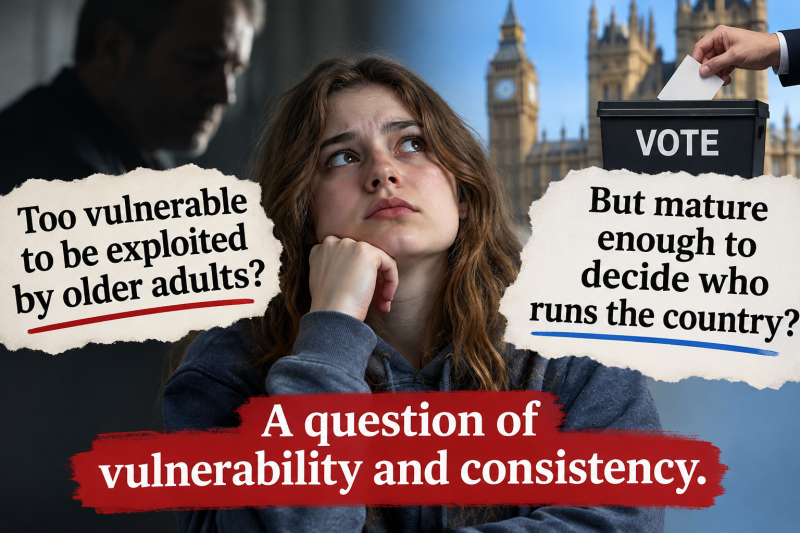
At the same time, the Government is pursuing plans to lower the voting age to 16, allowing teenagers to influence national elections and the policies that shape Britain's future. But surely the central issue is vulnerability to manipulation itself, not simply the circumstances in which that manipulation occurs. If the argument for additional protection is that 16- and 17-year-olds may lack the experience or confidence to recognise when an older adult is exploiting their trust, why would that vulnerability necessarily disappear when the influence is political rather than sexual?
Manipulation can take many forms. It can involve emotional pressure, persuasion, misinformation or the exploitation of someone's inexperience. A young person who is vulnerable to undue influence in one area of life may also be vulnerable in others. The Government should therefore explain why it considers 16-year-olds sufficiently independent to make decisions about national policy while simultaneously recognising that they may require additional protection from adult influence.
What About the Children Already Failed?
Perhaps the more pressing question is why we are discussing additional safeguarding legislation when existing laws have repeatedly failed to protect children under 16 from organised sexual exploitation. The grooming gangs scandal exposed devastating failures by police, local authorities and other institutions entrusted with protecting vulnerable children. These children did not lack legal protection. They lacked effective intervention from those responsible for enforcing it.
New laws may have a legitimate purpose, but legislation alone cannot prevent abuse if warning signs are ignored, victims are not believed and authorities fail to act.
Before promising further protection, the Government must demonstrate that the safeguards already in place are working.
The Question of Political Influence
If the Government accepts that young people can be vulnerable to manipulation by older, more experienced adults, surely that concern should extend beyond sexual relationships. Political parties have an obvious interest in securing votes, including those of 16- and 17-year-olds who would gain the right to vote under the Government's plans. This is particularly relevant when we consider that political influence can involve emotional pressure, persuasion and the exploitation of limited life experience. If politicians recognise this vulnerability, how can they justify extending voting rights without also addressing the risk that young people could be manipulated for political gain?
That does not mean every 16-year-old is incapable of independent thought, or that political persuasion is equivalent to sexual exploitation. However, recognising vulnerability in one context should prompt serious consideration of how young people can be protected from undue influence in others. Therefore, the Government must explain how it intends to safeguard young voters from manipulation while ensuring that decisions about giving 16- and 17-year-olds the right to vote are made in the public interest rather than for potential political advantage.
Final Thought
Nobody should oppose protecting young people from exploitation. But vulnerability cannot simply be treated as relevant in one area of life and irrelevant in another without a convincing explanation.
If the Government believes 16- and 17-year-olds require additional protection because older adults can exploit their inexperience, it must acknowledge that manipulation is not exclusively sexual.
Meanwhile, children under 16 have already suffered horrific abuse despite existing legal protections.
Before introducing new laws or extending new responsibilities, the Government must demonstrate that it understands the vulnerabilities of young people, can protect them from exploitation and can enforce the safeguards already in place.
Because if young people are vulnerable to manipulation, the question should not simply be who they are having relationships with, but who else might be taking advantage of their vulnerability.
Add comment
Comments