

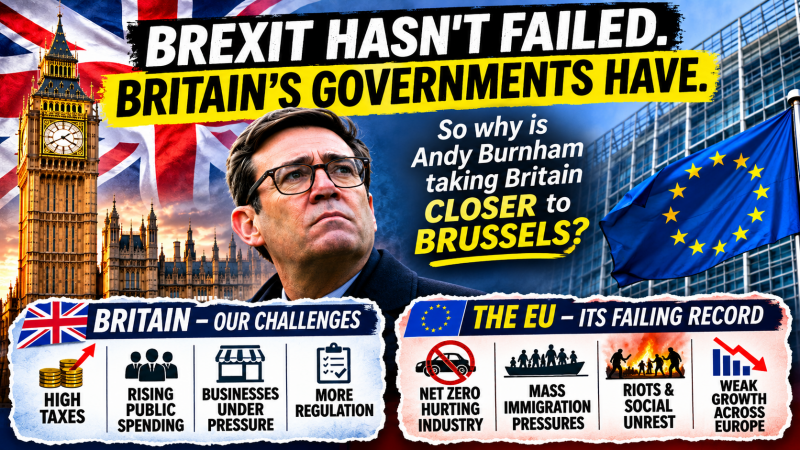
The British people voted for independence in 2016. Ten years later, why are politicians still looking to Brussels for answers to problems created by Westminster?
There is something deeply troubling about politicians declaring that Brexit has failed while refusing to acknowledge their own responsibility for Britain's economic and political difficulties. Andy Burnham's arguments for closer ties with the European Union raise a fundamental question: has Brexit failed Britain, or have successive governments failed to take advantage of the independence that the British public voted for? If Britain is struggling as an independent country, the first place we should look for answers is Westminster, not Brussels.
Independence is not a failed policy. Bad government is.
The British People Voted to Leave
In June 2016, 17.4 million people voted to leave the European Union. It was the largest number of votes cast for either side in a UK referendum at that time, and the instruction was clear: Britain should leave the EU.
That decision did not come with an expiry date. Nor was it conditional upon politicians deciding, ten years later, whether they approved of the outcome. Yet the Labour Government's pursuit of closer EU alignment risks moving Britain back towards arrangements that voters believed they were leaving behind.
The Government insists that its approach does not amount to rejoining the EU, the single market or the customs union. But formal membership is not the only question that matters. If Britain increasingly agrees to follow European rules, limits its ability to diverge from them and accepts financial consequences for withdrawing from agreements, we must ask how much practical independence remains.
Sovereignty is not simply about whether Britain has a seat in Brussels. It is about who ultimately makes the decisions that govern British businesses, taxpayers and families.
Brexit Hasn't Failed. Westminster Has.
For years, politicians have blamed Brexit for Britain's economic difficulties. But many of the country's most pressing problems are the result of domestic political decisions. High taxation, excessive borrowing, rising welfare expenditure, burdensome regulation and the costs associated with government energy policies are all matters over which British governments exercise substantial influence.
These problems did not suddenly appear when Britain left the EU. Many developed over decades under successive Conservative and Labour administrations. Brexit did not force governments to increase taxes. It did not require them to allow public spending to become unsustainable. Nor did it prevent them from encouraging entrepreneurship, investment and economic growth.
That does not mean leaving the EU has carried no economic costs. Trade barriers and additional administrative requirements have created genuine difficulties for some businesses. But acknowledging those difficulties is not the same as accepting that independence itself has failed. This distinction matters because blaming Brexit can become a convenient way for politicians to avoid responsibility for their own decisions.
If Britain is being badly governed, the answer is to govern it better.
The European Union is Failing
We are repeatedly told that Britain cannot prosper outside the European Union. Yet the EU is struggling with its own problems: weak economic growth in several major economies, contentious immigration policies, pressure on public services and widespread social unrest.
Across Europe, protests have erupted over migration, housing shortages, living costs and government policies. Some have descended into riots and violent confrontations with police. These are not all immigration-related, but they expose growing public dissatisfaction and political division.
Germany provides a stark economic warning. Its once-dominant automotive industry, built around the internal combustion engine, has faced enormous pressure from the EU's Net Zero transition, high energy costs and competition from China. Germany's decision to abandon nuclear power has added to its industrial challenges, while the country has pushed for greater flexibility over the EU's 2035 combustion-engine restrictions.
Why should Britain surrender more of its independence to an organisation struggling with so many of the same economic and social problems?
The Real Danger: Making Independence Too Expensive to Exercise
Perhaps the most concerning aspect of the proposed EU reset is the possibility that future governments could face financial penalties or compensation obligations if they choose to withdraw from particular agreements.
Reports suggest that provisions under discussion could require compensation for certain costs arising from termination. The precise wording, scope and financial exposure matter enormously. A negotiated compensation mechanism is not necessarily an unlimited exit penalty, and it would be misleading to suggest otherwise before the final agreement is published. Nevertheless, the principle deserves serious scrutiny. A government elected today should not casually enter arrangements that make it prohibitively expensive for a future government to pursue a different policy.
International agreements inevitably create obligations, and Britain must honour its lawful commitments. But there is a difference between responsible international cooperation and designing agreements that deliberately discourage future democratic change. If the Government believes these arrangements are beneficial, it should publish their full terms, explain the potential costs and allow Parliament meaningful scrutiny, because the British taxpayer should not be presented with an expensive bill simply because a future elected government wishes to exercise a different political mandate.
Is Britain Becoming a Nanny State?
We have become accustomed to politicians presenting government intervention, additional regulation and higher public expenditure as the solutions to almost every problem.
Yet Britain's economic strength has historically depended heavily on enterprise, innovation, international trade and the willingness of individuals to build businesses and create employment. Therefore, small businesses should be encouraged to grow, not continually confronted with rising costs and administrative burdens. We should be creating a country where investment is attractive, work is rewarded and entrepreneurship is celebrated. That requires sensible taxation, competitive energy costs, proportionate regulation and responsible public finances. None of those objectives requires Britain to re-join the European Union. Nor should closer alignment be used as a substitute for making difficult domestic decisions.
The freedom to pursue policies suited to Britain's own circumstances was one of the opportunities Brexit created. The failure to use that freedom effectively is a criticism of government, not necessarily of independence.
Labour Must Answer for Its Decisions
The Labour Government has every right to negotiate international agreements. But having the legal authority to negotiate them does not remove the political obligation to explain their consequences. If closer EU alignment requires Britain to accept rules it cannot independently determine, the public deserves to know. If agreements involve substantial financial contributions, those costs should be transparent. And if withdrawal could trigger compensation obligations, Parliament and the public should understand exactly what those obligations mean.
The Government cannot reasonably expect voters to accept vague assurances that these arrangements are in Britain's interests while withholding the detail needed to assess them. Nor should ministers dismiss legitimate concerns about sovereignty as nostalgia or an unwillingness to cooperate internationally. Britain can trade with Europe, cooperate on security and maintain constructive diplomatic relationships without surrendering its ability to make independent decisions.
Those objectives are not mutually exclusive.
Final Thought: The Problem Is Not Independence. It Is Accountability.
Brexit did not promise that Britain would suddenly become prosperous, that every government would make sensible decisions or that every economic difficulty would disappear. It offered something more fundamental: the opportunity for Britain to determine more of its own future. That opportunity places greater responsibility on the politicians governing us. They can no longer blame every failure on decisions made in Brussels. Perhaps that is the uncomfortable truth at the heart of this debate.
If our taxes are too high, our public services are struggling, our businesses are burdened and our national finances are deteriorating, we should demand answers from the people making those decisions. We should not automatically accept that transferring more influence back towards the European Union will solve problems created by British governments. The 17.4 million people who voted to leave did not vote for independence only until politicians decided it was inconvenient. They voted for a country capable of governing itself.
Britain does not need Brussels to rescue it from bad government. It needs a government capable of making independence work.
And before Andy Burnham or anyone else asks the British public to accept further European commitments, they should answer one simple question:
Why should future generations surrender any part of their independence to compensate for the failures of the politicians governing Britain today?
Add comment
Comments