

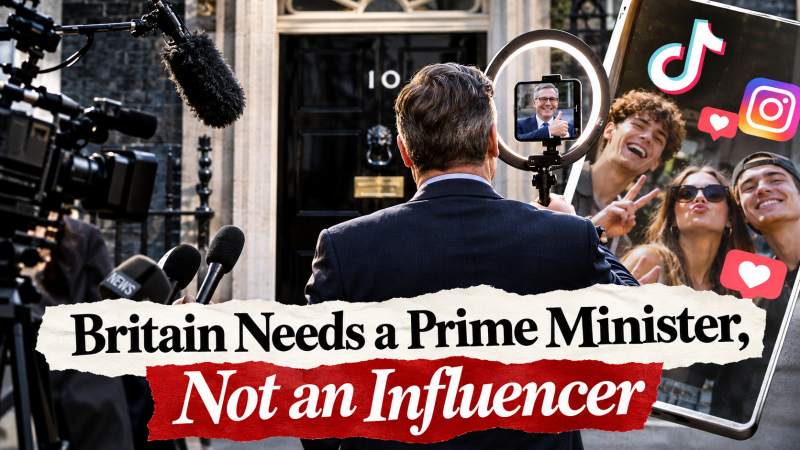
Whilst Britain faces serious economic and social challenges, Downing Street appears increasingly preoccupied with TikTok, social media influencers and chasing public approval.
The recent controversy surrounding influencers invited to Number 10 raises questions not only about the dignity of the office of Prime Minister but also about the government's priorities and its willingness to face genuine scrutiny.
Progressive Values – When Convenient
Labour frequently reminds us of the importance of tackling violence against women and girls, challenging misogyny and being mindful of the language we use. Yet an influencer invited to Downing Street subsequently posted a video outside Number 10 featuring language criticised as degrading towards women.
Had a prominent right-wing figure used similar language, would Labour have been quite so forgiving?
Whether the influencer intended to cause offence is almost irrelevant to the wider political argument. Labour has repeatedly promoted the importance of language and its impact on others. Surely, by its own standards, those principles should apply equally to everyone.
You cannot occupy the moral high ground only when it is politically convenient.
Popularity Over Accountability
Perhaps more concerning is the apparent preference for engaging with social media influencers rather than submitting to rigorous questioning from experienced political journalists. There is nothing inherently wrong with politicians using social media to engage younger audiences. However, carefully managed content and friendly interviews are no substitute for independent scrutiny. Unlike many TikTok influencers, professional journalists can challenge government policies, interrogate statistics and ask uncomfortable follow-up questions. Therefore, democratic accountability requires a Prime Minister to answer difficult questions, not simply surround himself with people who are unlikely to ask them.
Being accessible is not the same as being accountable.
Meanwhile, Back in the Real World
Whilst Downing Street entertains influencers, the British public faces considerably more pressing concerns:
-
Rising living costs and unaffordable energy bills.
-
Youth unemployment and diminishing entry-level employment opportunities.
-
The potential impact of artificial intelligence on the labour market.
-
The financial implications of closer alignment with the European Union.
-
Concerns over Britain's energy security and economic competitiveness.
Young people do not need a Prime Minister who understands TikTok trends. They need employment opportunities, affordable housing and the prospect of financial independence.
A social media video will deliver none of these things.
Stop Treating the Symptoms
Successive governments have become increasingly reliant on financial interventions to compensate for problems that their own policies have arguably helped create. Yet, rather than addressing the underlying causes of expensive energy, governments offer temporary financial assistance, and rather than creating the conditions for sustainable economic growth, they announce initiatives, subsidies and promises of future prosperity.
Why not address the structural problems in the first place?
Britain needs a competitive energy market, greater energy independence, a thriving private sector and an economy that generates genuine employment opportunities. The measure of successful government should be how well the country functions, not how frequently the government intervenes to compensate for its failures.
Final Thought
The Prime Minister's job is not to accumulate followers, generate likes or seek validation from social media audiences. It is to govern, make difficult decisions, accept scrutiny and deliver measurable improvements to the lives of British citizens. Leadership sometimes requires making unpopular decisions. It requires conviction, competence and the ability to withstand criticism.
Britain does not need another influencer.
It needs a Prime Minister who is more concerned about the country's future than his own popularity.
Add comment
Comments