

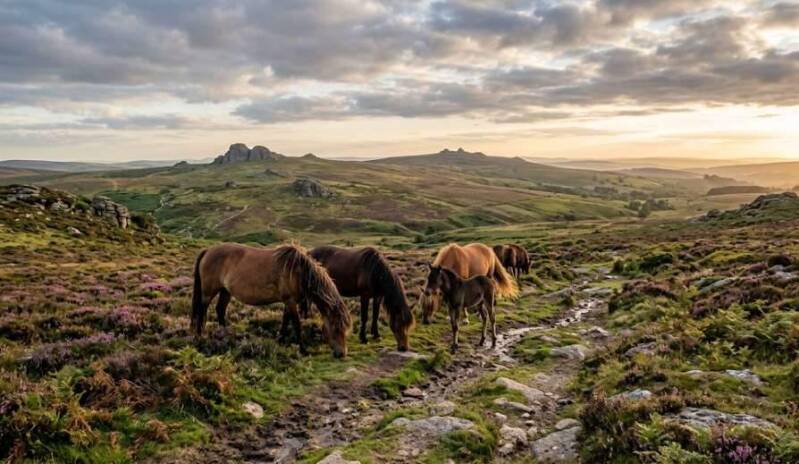
The misty, rugged expanses of Dartmoor National Park have been shaped by semi-wild ponies since the Bronze Age. This week, however, these cultural icons found themselves at the centre of an intense political and environmental row, with alarming headlines warning of a mass slaughter of up to 93% of the remaining herds.
If you have seen the panicked social media posts or the petitions to “save the ponies,” you might be wondering how a nation of animal lovers reached this point. Let’s break down the reality behind the guidelines issued by the Department for Environment, Food and Rural Affairs (Defra) and the conservation group Natural England.
The Root of the Crisis: A Bureaucratic Blunder
To understand why campaigners are worried, you have to look at the paperwork rather than a deliberate plot.
Defra and Natural England have been rolling out new Environmental Land Management (ELM) and Countryside Stewardship contracts. These schemes pay “commoners”—the local farmers who have ancient rights to graze livestock on the moor—to reduce grazing numbers in order to protect rare flora and recover overgrazed landscapes.
The tension stems from a major policy shift:
- The Old Rules: For decades, environmental schemes capped numbers for commercial sheep and cattle but excluded hill ponies. This protected the herds as a heritage exception.
- The New Framework: In an effort to address overall overgrazing, a policy change initially drafted in 2023–2024 grouped the ponies into the general “livestock unit limits” alongside commercial cattle and sheep.
- The Financial Catch: The new rules require commoners to slash their overall livestock numbers drastically—by 56% to nearly 90% on some commons. Because farmers can sell sheep and cattle commercially for meat, they face an impossible financial incentive to remove the unprofitable ponies first to keep their farms viable.
The Dartmoor Hill Pony Association (DHPA) warned that if these rules are strictly enforced during the annual autumn round-ups, the majority of the remaining 1,000 ponies could be taken off the moor with nowhere to go, inevitably resulting in a mass cull.
The Eco-Paradox of the Guidelines
What makes this situation so frustrating for locals and conservationists is that culling the ponies directly contradicts the goals of habitat restoration.
Dartmoor is currently battling a massive takeover by Molinia (purple moor grass)—an invasive, coarse plant that chokes out native wildflowers and heather. While commercial sheep prefer delicate, nutritious plants, ponies aggressively eat tough, unpalatable Molinia and gorse. Stripping the moor of its best natural lawnmowers would actually harm biodiversity, not help it.
The independent, government-commissioned Fursdon Review previously concluded that ponies and cattle should never be linked for the calculation of stocking rates. Yet, the recent Defra guidelines failed to make that distinction.
The Government’s Response: Are the Ponies Safe?
As public outrage mounted and political leaders across the spectrum condemned the oversight, Downing Street intervened.
A spokesperson for Prime Minister Sir Keir Starmer stated unequivocally: “This Government will not allow a cull of Dartmoor ponies, and we don’t manage pony populations by culling in this country.” Natural England similarly clarified that they have never recommended or desired a cull, and praises the animals’ immense ecological and cultural value.
Government allies have since declared the ponies “safe,” but campaigners warn that a verbal promise is not enough.
What Needs to Happen Next?
While the immediate panic has subsided, the underlying policy problem remains unresolved. For the ponies to truly be safe long-term, Defra must act on the following points:
- Introduce a “Carve-Out” Rule: Change the agri-environment scheme metrics so ponies are completely separated from commercial sheep and cattle limits.
- Establish a Fixed Herd Size: Implement a separate, legally protected moor-wide herd size (targeting 1,000 to 2,500 head) rather than fluctuating limits.
- Await the Land Use Plan: Pause rigid stocking mandates until the Land Use Management Group completes its comprehensive Dartmoor framework, which is expected to balance farming, heritage, and nature.
Final Thoughts
The Dartmoor pony crisis highlights a critical lesson in modern conservation: you cannot save an ecosystem by drafting rigid bureaucratic formulas that ignore the actual animals and farmers who sustain it.
What are your thoughts on how the government handles upland farming and conservation? Let us know in the comments below, and don’t forget to share this post to keep the awareness alive!
#SaveTheDartmoorPonies #NaturalEngland #CountrysideAlliance
Add comment
Comments