

Imagine sitting down with a mortgage advisor, handing over your financial statements, and asking for a loan.
You explain that your total household debt is over 100% of your annual income. You add that you have no concrete plan to pay it down, your supermarket bills are being put on a credit card, and your strategy to fix things is to borrow significantly more.
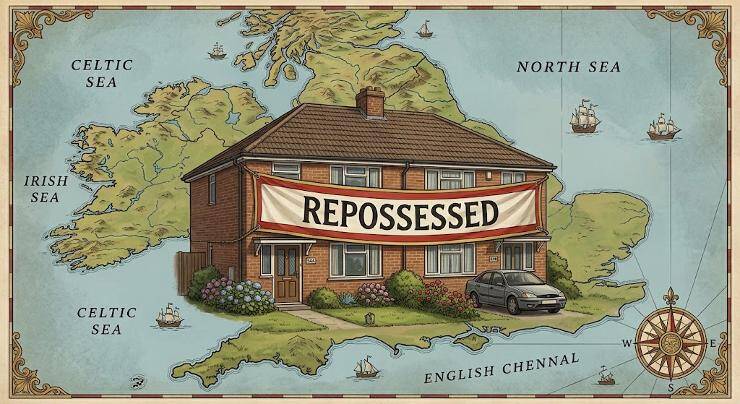
The advisor wouldn’t just reject your application; they would laugh you out of the bank. If the UK economy were a residential property, the bailiffs would already be at the front door changing the locks.
Let’s look at the brutal reality of the UK’s balance sheet by comparing our national debt to a standard domestic mortgage.
The Reality Check: LTV and Repayments
In the world of personal finance, two metrics rule supreme: Loan-to-Value (LTV) and Affordability. When we apply these to the UK, the math completely falls apart.
When buying a home, your Loan-to-Value (LTV) ratio is typically kept between 60% and 90%, ensuring you own genuine equity in the brick and mortar. The UK economy "house", however, is deeply negative equity. Our LTV is over 100%, meaning our skyrocketing national debt completely exceeds our entire GDP—the nation's total annual economic output.
The contrast in Repayment Type is just as alarming. A standard domestic homeowner is forced onto a Capital and Interest mortgage, where you gradually pay off the actual debt over a structured 25 to 30 years. The British government, by comparison, operates on a permanent Interest-Only basis. Westminster never actually pays off the principal sum; they merely service the interest fees while rolling the massive core debt over to the next generation forever.
This fundamentally breaks the rules of Monthly Cost Impact. For a normal family, monthly mortgage repayments are strictly capped by strict bank income stress-tests so you can still afford food, heating, and basic utilities. For the country, these interest repayments have become suffocating. Debt interest payments consume billions of pounds every single month, completely starving our vital public services of cash.
If a private citizen ran a household budget like this, a court order for repossession would be a certainty. We are living in a national house built on shifting sands, completely dependent on the goodwill of external lenders to keep the lights on.
Bailing Out the Titanic with a Teaspoon: Small-Scale Policies
Instead of investing the necessary capital to underpin the cracking foundations of this house, Westminster is focused on window dressing. We are told that big structural changes are happening, but the hallmark policies of leadership are small-scale distractions.
Take Andy Burnham's state-subsidised bus fare caps or Keir Starmer's national roll-out of primary school breakfast clubs. While a £2 bus ride or a free morning meal might sound like comforting neighbourhood initiatives, they represent an entirely unserious approach to a macroeconomic crisis.
Neither of these policies addresses the elephant in the room: systemic, long-term national decline. Funding free breakfast sessions and bus subsidies while ignoring a collapsing multi-trillion-pound balance sheet is the equivalent of a homeowner obsessing over matching kitchen curtains while the roof is caving in. It is minor tinkering while avoiding the real structural issues plaguing the British economy.
The Bond Markets: Far Worse Than Liz Truss
We all remember the autumn of 2022. Liz Truss’s mini-budget sent the gilt (UK government bond) markets into a tailspin, spiking borrowing costs and crashing the pound. It was treated as a historic economic disaster, with 30-year bond yields momentarily hitting a peak of 4.9%.
But look at the bond markets today. The situation has far exceeded the Liz Truss crisis.
Long-term government borrowing costs have marched well past those 2022 peaks, with the 30-year gilt yield soaring to a 28-year high of 5.9% (At the time of writing). The underlying pressures on UK gilts have become increasingly systemic and entrenched compared to that short-term shock. Because the total debt pile has continued to grow, even minor yield fluctuations now cost taxpayers billions. The market is pricing in long-term, chronic structural weakness. Investors are demanding a massive premium to hold British debt because they see a structural deficit that no one in Westminster seems willing to fix.
The Only Real Solution: Cut Borrowing, Don't Increase Taxes
When the Labour government took power, they made one thing abundantly clear: there will be no return to austerity. If you pledge to inject billions into public services, refuse to cut spending, and face strict political limits on how high you can raise income tax, there is only one mathematical lever left to pull: Borrow more.
Instead of tightening the national belt, the strategy relies on borrowing heavily to fund state-led investment, under the gamble that this will magically trigger massive economic growth.
But if the government genuinely wants to fix this broken household budget, there is only one viable formula left: we must radically cut state borrowing and flatly refuse to increase taxes.
For too long, politicians have leaned on the lazy assumption that economic shortfalls can be taxed away. But raising taxes further on an already overburdened workforce and struggling business sector stifles productivity, suffocates growth, and chases investment out of the country. You cannot tax a nation into prosperity.
My previous blog outlines the issues with over taxation and the impact on economic growth
https://www.daniellasdesk.com/3263309_the-stifled-economy-why-leaving-cash-in-consumer-pockets-generates-more-tax-than-freezing-wealth
Similarly, the "no austerity" pledge cannot be an open invitation to treat global bond markets as a bottomless credit card. Borrowing more money to pay off the interest on your existing debt is the definition of a debt spiral. If a homeowner tried to solve a mortgage crisis by taking out massive new personal loans to renovate the kitchen, they’d be fast-tracking their eviction. To rescue the British house from foreclosure, the state must live within its means. We need aggressive fiscal discipline that stops the government from competing with private markets for debt, pushes down interest yields, and leaves money in the pockets of taxpayers to actually stimulate the economy.
The Bottom Line
The UK is currently operating on economic rules that would bankrupt any family in the country. Shifting money around to fund breakfast clubs and cheaper bus routes does nothing to stop the bleeding. By treating the national wallet as a bottomless credit facility, we are pushing the boundaries of what the global bond markets will tolerate.
Without a serious pivot toward cutting borrowing and protecting wealth from further taxation, we aren't just managing an economy—we are managing a property that is spiralling toward foreclosure.
Add comment
Comments